You’ve Gotta Laugh! – Humour in the Workplace
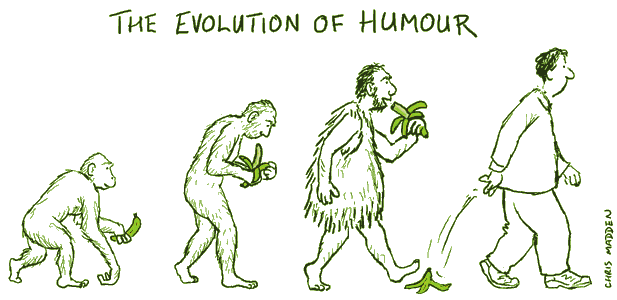
We laugh so often that we never stop to ask what is it for. In fact ask the question and the recipient will be waiting for the punchline (thinking it is a joke!). But in a business context what is humour for? Why do we have some of our best times when we enjoy a good laugh in a group? Are there negative aspects to humour? Why do we sometimes feel angry or hurt when in a group that are laughing at a joke – maybe at our expense?
Well, like many of the social tools we use, humour is such a part of our human interactions that we use it and react to it unconsciously. But where did it come from and where did it start?
Some scientists reckon that humour was originated to help with procreation.
Scientists have proposed a variety of evolutionary theories of humour that mostly boil down to getting an edge in the chase for a mate. American evolutionary biologist Richard D Alexander, for example, suggested in his 1986 book Ostracism and Indirect Reciprocity: the Reproductive Significance of Humour, that the point of telling jokes was to raise one’s own status, lower that of certain other individuals, and enhance social unity…..And to get laid.
In the work environment, status is important and humour is used with varying degrees of success to raise that of the joker and reduce that of the target. If you are the target of an experienced joker, you may be seething inside but will have to laugh along as you find it impossible to find enough ground to take issue. How many times have you thought up a witty riposte hours later and wished you could have used it.
Humour is sometimes used to make serious points and to communicate messages that the originator cannot or is afraid to communicate seriously. This a poor use of humour as again it may be divisive.
Humour for social unity is one that we all enjoy because it is inclusive and non divisive whereas status driven humour may be exclusive and divisive. Status humour about groups can include social unity as a by product but it applies to specific groups inhabited by the joker.
So use humour in the workplace to promote social unity, to release tension and create a friendly and enjoyable workplace.
Beware of humour that promotes individual status or agendas.
Leadership Insights
Leadership Questions

Leadership has historically caused much debate and raised many questions:
- Are leaders born or made?
- What makes a leader?
- Do different environments require different leaders.?
- Is a leader, a leader all of the time?
The good news is that we all can be leaders. It requires the right circumstances. It requires practice.
We will not be leaders all of the time but we need only be leaders for enough time to get the job done.
The following will explore these questions in more detail.
What is leadership?
Aristotle defined leadership as requiring Knowledge,Skills and Practical Wisdom – the ability to see the good and realize it in a specific situation. All three are necessary and mutually supportive.
In The Art of War, Sun Tzu characterized leadership as a mix of five traits: Intelligence, Credibility, Humaneness, Courage, and Discipline.
Montgomery defined leadership as:
“The capacity and will to rally men and women to a common purpose and the character which inspires confidence”.
The Arbinger Institute talks about self deception & “being in the box”. Being “in the box” means being being boxed in by your fears, doubts, uncertainties and limiting beliefs such that you do not connect with others and do not focus on that you care about. Good leaders are honest with themselves and are ” in the box” much less of the time.
Peter Drucker states “Your first and foremost job as a leader is to manage your own energy, and help manage the energy of those around you”.
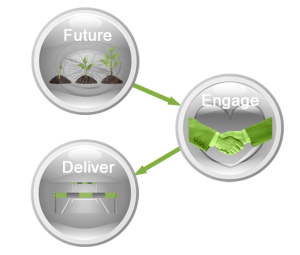
Steven Radcliffe talks about a leader:
- Creating a vision of a better future
- Engaging a team to commit their energy to deliver such a future
- Delivering results
As a leader, you must care for a better future
Leadership is not just about competencies, skills and personality. It’s first and foremost about being in touch with what you care about and then going for it. You won’t be a great leader for things you don’t care about!
By its nature a better future involves working in areas that are new and where you are instigating change to achieve this better future. Managers normally focus on delivery within defined parameters and deal with much less uncertainty.
A better future requires strategy and planning once the idea has been conceived. This will ensure that it is indeed a better future.
You must be at your best more of the time
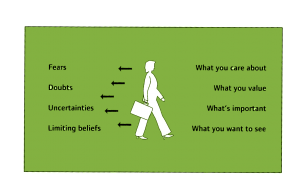
Peter Drucker states “Your first and foremost job as a leader is to manage your own energy…..and then help manage the energy of those around you”.
It does all start with you, how you manage yourself to be at your best more of the time.
If you are at your best, you are focussed on the future and not held back by the present. You are more engaging and this creates a powerful platform to help others to be at their best.
The Arbinger Institute talks about “being in the box”. Being in the box means not being being boxed in by your fears, doubts uncertainties and limiting beliefs such that you do not connect with others and do not focus on that you care about. Good leaders are in the box much less of the time.
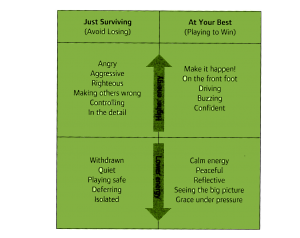
All of us have the capability to be leaders but we need to believe in ourselves as a leader and get into the right frame of mind. An effective leader is “Playing to Win” and is not just “Trying not to Lose”. As an effective leader you are “At Your Best” and not “Just Surviving” . An effective leader will exhibit high energy or low energy at different times for different tasks. These are not fixed states. We all are in all of these some of the time. We will not be leaders all of the time. But the best leaders manage to be in “Play to Win” and “At Your Best” states most of time.
You must help others be at their best more of the time
Leaders must make big requests so they must have relationships that are big enough to get the job done.
They must help people be at their best. They must help them overcome their limitations – their fears, doubts, uncertainties and limiting beliefs and to focus on what they care about.
Leaders must look for and remove obstacles in the environment that are hindering team progress.
You must engage others to care about your vision of the future.
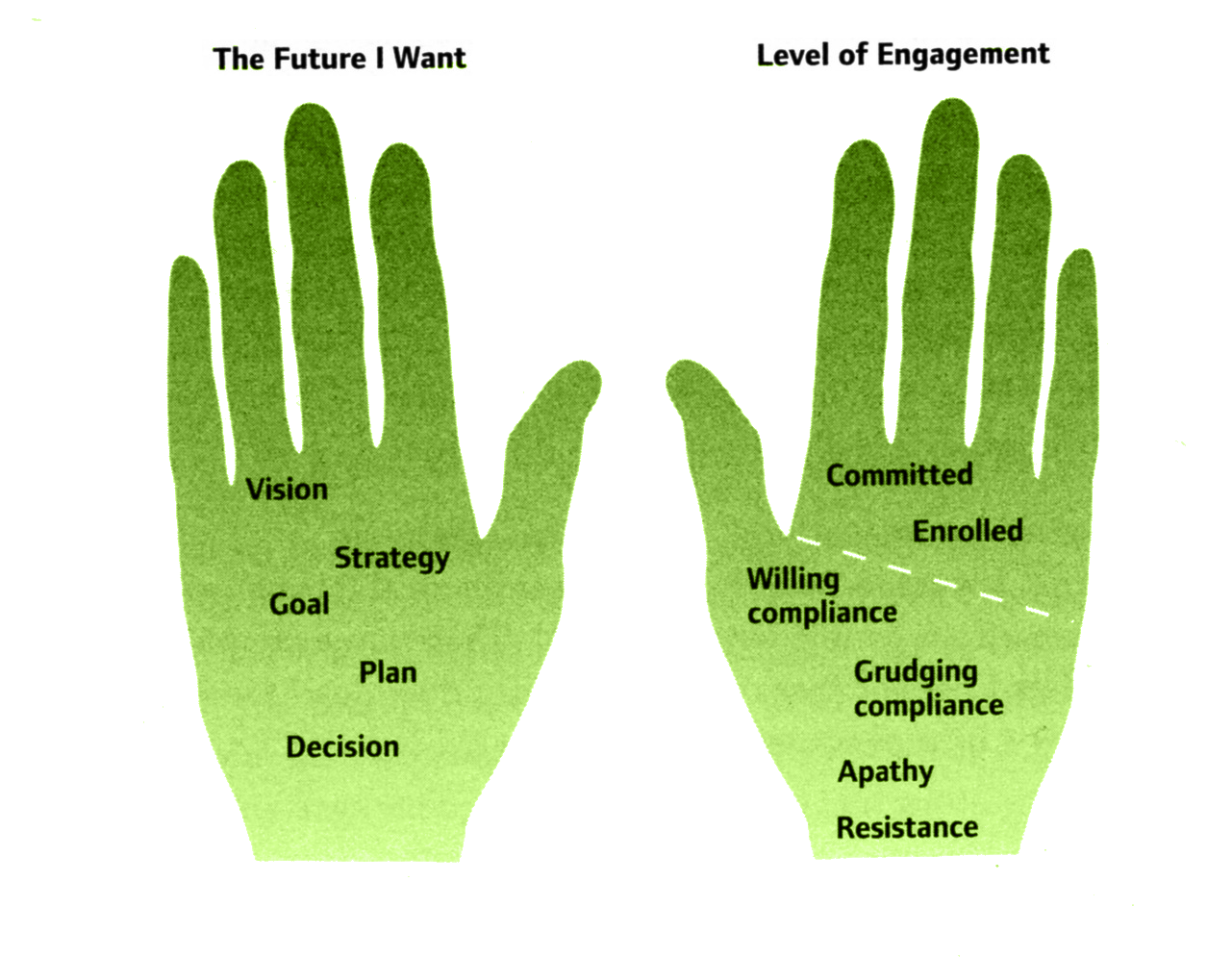
Engage people so they want to work with you and build a future with you.
Crucially engagement is absolutely distinct from ‘communicating to’, ‘presenting at’ or telling.
It is about how you connect with people, how you stimulate their thinking and impact their energy.
Engaging others is a two-way interaction and its something that happens inside your relationships. It is about your ability to build relationships big enough to get the job done.
Engagement is about taking people through resistance, apathy, grudging compliance, willing compliance, to enrolled and finally to committed.
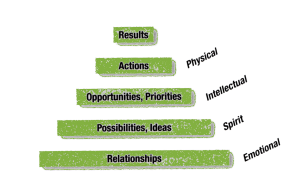
Engagement is:
- supported by building Relationships big enough to get the job done
- fuelled by Possibilities that others can see for themselves linked to the Future they want
- sharpened by agreement on specific Opportunities and Priorities
- creating a bridge to Deliver by making Big Requests of others to elicit Promises to take Action.
You must deliver results
Delivery is not standalone
Delivery is where we are all judged, is the most visible part of leadership but is not standalone. Without a compelling Future and without engaging in that future delivery of the right results will not happen.
Delivery requires you to mean it
To get great delivery you have to mean it when you make big requests. Meaning it means that your team is in no doubt of your expectations from what you say and from what you do.
For instance…making too many requests may well mean that none are done well. Not following up may mean that your team becomes distracted. Remember the maxim ” people do what you inspect, not what you expect”. There are no avoiding some difficult converstations when performance falls below that required or expected.
In delivery a leader is expected to exhibit fierce resolve, emotional fortitude, focus, discipline and resilience to ensure that the team remains focussed, acts with high energy and delivers results.
Deliver today but grow people to deliver even more tomorrow
Get the best from yourself and others today but commit to growing yourself and others so that the capability to deliver increases into the future.
How do we become leaders?
We become leaders through 1. Conscious Practice, 2. Using a Personal Support Team 3. Knowing and Going beyond our limits and 4. Being in the right State of Mind.
Conscious Practice.
Conscious Practice. You do most of your learning in real-life situations and the more you practice the better you get. Consciously use situations and challenges as opportunities to learn and grow.
- Be guided by the future you want
- Embrace the big picture
- Engage rather than transmitting/communicating
- Build Big Relationships
- Manage your Shadow (Don’t be “in the box”, manage yourself such that your uncertainties or anxieties do not cast a shadow on your team. Be in a position to help your team be at their best)
- Make Big Requests
- Maximise Probability of Delivery
- Acknowledge acceptable Delivery
- Fix Delivery that has problems
- Wrap Up
Use a Personal Support Team
Use a personal Support Team for feedback. Identify the specific ways you want to grow as a leader, tell selected colleagues and ask them to rate you now. Then ask them if they’ll watch out for you in these areas to help you make progress.
Know and go beyond your limits.
- Get beyond the present
- Embrace the big picture
- Accept that you will not know how to achieve your Future
- Believe you are a leader
- Be in leader mode (rather than operator/manager mode)
- Overcome: I’m only….I’m not….I’m just…
Be in the right state of mind
Recognise your state of mind and work out how to ensure you are “At Your Best” and “Playing To Win”.
Recognise the triggers that push you into “Just Surviving” mode and ensure you manage or avoid them to spend more time “Playing to Win”.
Sales Strategy
 Strategy & Tactics
Strategy is best defined as “doing the right things” while tactics is best defined as”doing things right”
Strategy is a planning process and tactics an action process. The borderline between the two in a sales context is market and customer contact.
The Strategy must be effective for the tactics to succeed longer term. Tactics may have some shorter term success with a bad strategy but will not compensate over the longer term.
A good strategy is simple, written and contains flexibility to adapt to reality.
The ultimate victory is to win before action. It will win without conflict. In business this is about choosing the markets and accounts with care and ensuring that the company is best organized to win.
The right strategy is essential but normally the battle is still only half won. The strategy requires and only succeeds with professional execution of tactics.
Combine Planning & Action
Problems arise if there is separation of planning and execution.
The important thing is to get started as too much planning can breed indecisiveness and error. It is often better to engage in some form of simultaneous planning and implementation.
A decisive plan may often only be created following some preliminary actions in the Market to determine competitive resources and customer real requirements.
Strategy seeks superiority and a good strategy ensures overwhelming superiority that as a result will guarantee success with effective execution of tactics.
Attributes of an effective Strategy
Customer comes first.
First satisfy the needs of the market. Then and only then can you profit from your actions. It cannot be the other way around.
Knowledge is power
Know yourself,your team,your product, your company, the market, the customers,the competition, the influences.
Fight battles that you can win.
Only compete with superiority. Look to win with ease. Concentrate strengths. Operations succeed because strengths are concentrated against weakness.
If real superiority is not achieved then we cannot predict success and may well fail. A business destined to fail competes in the hope of winning.
The objective is not an equal match but an unequal advantage in your favour. As Napoleon said “God is on the side of the heaviest artillery”.
Choose when and where to take on the competition.
Create a strong position
Try to become invincible and await for vulnerability in the competition. Use resources wisely.
Be flexible.
Adopt different strategies for different market and competitive conditions. No victory is the same as another.Take advantage of opportunities. Act when others are unprepared or make mistakes. Take the initiative. Make time your ally.
The strategy is driven by how early the opportunity or market is entered and the status of company resources and product.
- Preferred Strategy:- Get in first and lead the way. Set the requirements, be the one that the competition is compared to.
- Secondary Strategies:- Where the opportunity or market is already active and in progress and there is most likely a competitor leading the way.
Seconary Strategies are split into Lead and Fallback strategies in order of preference:-
- “End Around”:- Change the requirements to suit vendor differentiators.
- “Head to Head”:- Compete head to head – best when resources are much larger than competition.
- “Divide and Conquer”:- When the vendor can’t win the whole opportunity. Often used as an account or market entry strategy.
- “Stall”:- Used when in account and when the vendor needs time to develop a competitive product.
Build a Committed Team
Engage team fully. Create a team fully committed to objectives. Ensure that the team is at its best more of the time
Use organization, process, training & communication.
Cultivate resources.
Use allies, partners & network effectively.
Keep them guessing.
Use surprise to ensure that competition does not know all about you.
Deliver
An effective strategy delivers results.
Contents of an effective Strategy
- Ensure that the Customer Profile is an addressable market segment with common needs and buying process.
- Ensure that the value proposition and sales process appropriate to address this customer segment.
- Update the Go-To-Market strategy as appropriate to best use sales and marketing resources and channels to efficiently address the sales process by product, by territory and achieve market segment coverage.
- Review and Update the Sales Team design to ensure it is fit for purpose including appropriate structure, size, roles, responsibilities and territories assigned.
- Review and Update the Market Share, Revenue, Margin and Sales Cost targets to ensure they are realistic and achievable.
Achieving Business Growth
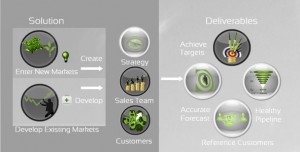
Challenge
The overriding challenge in sales and marketing is “To deliver business growth”.
How to Address
Take the right approach.No one size fits all. So to be most efficient and effective it is best to:
- Diagnose Challenge,
- Create Solution & then
- Deliver Results.
The challenges will fall into two broad categories
- Enter new markets or
- Develop existing ones.
Diagnose Challenge
The main ingredients of success are:
- Strategy,
- Sales team (& infrastructure),
- Customer acquisition( tailored sales process, product value, & customer references)
Create Solution
Following the diagnosis of the challenges a bespoke solution may be created.
Create/Develop Strategy
Planning means that subsequent action will effective and efficient.
- Create customer profile,
- Value proposition,
- Go to Market strategy,
- Sales process,
- Sales team,
- Targets.
Create/Develop Sales Team
This includes Leadership, Scalable Sales Model and Hiring the best people.
Leadership means that the team energised, have clear objectives, are fully engaged and deliver the required targets wit the required cost. The team is supported by a scalable sales model which includes:
- Sales Process based on Customer Buying Process
- Sales Management System to to deliver forecasts and processes for coaching and performance management
- Sales Automation that improves the efficiency of communication, customer database and reporting.
- Marketing Integration for lead generation, sales tools, messaging and effective market coverage.
Hire the best people. Utilise a clear and professional process to identify and develop people with high potential.
Begin/Develop Customer Acquisition
Customer Acquisition is vital for revenue Growth and the creation of references to enable later customers to be acquired more efficiently. Both are key attributes of business growth.
First ensure product delivers compelling value. as perceived by the customers. Then create or develop references.
To win major breakthrough accounts will require the creation of a tailored sales process based on the customers buying process. This will help harness the resources of the company effectively, manage communication and monitor progress.
Deliver Results
Results will be best delivered by effective leadership and professional project management.Leadership ensures that clear objectives are set and resources to deliver such objectives are secured.Then the team to deliver the results is engaged such that they are fully committed to deliver superb results.Finally the results are delivered with progress monitored and reported on at regular intervals to keep stakeholders informed.
Creating Customer Solutions
Understand: the Customer’s Business Model
A business model is made up of the following elements:
- Customer Segments Served: Who are they creating value for? Who are their most important customers?
- Value Propositions: What value are they delivering to customers? What customer’s problems are they helping to solve? Which customer needs are they satisfying?
- Channels to Market: Through which Channels do their Customer Segments want to be reached? How are they reaching their Customer Segments now?
- Customer Relationships: What relationships do each of the customer segments expect? What ones have been established? How costly are they?
- Revenue Streams: What value are customers willing to pay and what are they currently paying?
- Key Resources: What key resources are required by Value Proposition, Channels, Customer Relationships & Revenue Streams?
- Key Activties: What key activities are required by Value Proposition, Channels, Customer Relationships & Revenue Streams?
- Key Partnerships: Who are their Key Partners & Key Suppliers. Which Key Resources are they acquiring from partners? Which Key Activities do partners perform?
- Cost Structure: What are the most important costs inherent in the business model? Which Key Resources are the most expensive? Which Key Activities are the most expensive
Diagnose: Pain Points
Diagnose where the customers pain points are in their business model:
- Find new customer segments?
- Create new value propositions?
- Reach customers more effectively?
- Increase Revenue Streams?
- Provide new key resources or key resources with better attributes?
- Increase key activities efficiency?
- Replace one of their key partners?
- Reduce cost structure ?
Create: Solution
Create a solution:-
- Define benefits
- Define investment
- Demonstrate capability using references and endorsements
- Communicate in customer’s language showing Return On Investment.
Communicate: Solution
Resolve concerns on solution, risk and price.
Communicate in customer’s language showing Return On Investment.
Deliver: Solution
Deliver the solution.
Use project management tools to manage delivery.
Demonstrate that benefits have been delivered. Ensure customer satisfaction.
The Art of Persuasion
Communication is a fundamental part of business and personal life. We now have many different ways of communicating from face to face to phones, social media, print media and broadcast media.
With all of these communication channels we are trying to inform, persuade, motivate, coach and manage relationships.
I would like to review a very important element of commuication: the art of persuasion. And I will limit my focus to B2B communication (mainly).
Win:Win Framework
Communication is always within a context or framework which may be implicit or explicit.
For some the word persuasion has ominous undertones and a worry about being manipulated.
I am assuming, in this discussion, that persuasion is used within a framework that assumes a (win: win) or positive outcome for both parties.
I assume that what I am persuading the customer to do will add value to the customer’s business and result in a (win: win) transaction.
Basic Persuasion Model
A basic persuasion model was constructed by Aristotle and consists of three elements:-
- Credibility – relates to the character and reputation of the persuader.
- Emotion or Empathy – the persuader must have the the ability to identify and understand the other person’s feelings, ideas and situation.
- Logic – relates directly to the logic of the argument.
Appealing to Credibility
In appealing to credibility, both the individual and the company he represents must be credible in the eyes of the audience. He must emit true sincerity.
Genuine sincerity means that you actually care about someone’s problems or concerns. It creates a certain amount of trust. And trust is the foundation of relationships.
The company builds its credibility on its successes and on its third party references. (In the B2B mainstream market (Early & Late Majority) positive references are key to credibility.)
The individual builds his individual credibility with integrity, historical success (supported by knowledge), skills and experience (as required by the audience). Initially the company brand will lend credibility to the individual but the individual must build and maintain his own over time.
In launching new products the phrase “Credibility before Visibility” is very apt. A lot of marketing and sales expense may be wasted in persuading the market to buy products that are not yet credible in the eyes of the target audience.
Appealing to Emotion
This using your heart as well as your head. It’s the ability to read emotions in others. It’s being able to experience from another person’s perspective. It is empathy.
It appeals to the emotions, imagination and self interest in the audience. In some cases to feel what the presenter feels.
The message evoking an emotional response may be delivered by words, messages but also by non verbal communication. The words may well be in the form of a story, a vision that transports the audience to understand the presenter’s point of view or to join him in envisioning the a particular part of the world as improved or as a better place. Music, colours, films, graphics etc. may be used to emphasize and communicate the required message.
Non verbal communication can give wither a positive or negative response. Such communication is delivered via facial expression, eye contact, gestures, posture and body orientation, humour, proximity, paralinguistics (tone, pitch, rhythm, timbre, loudness and inflection of voice), dress sense, attitude & confidence.
Emotion also includes building a relationship and a rapport that can reduce barriers to communication and engender trust which is a foundation of all human intercourse.
Appealing to Logic
Persuasion Techniques
Whilst techniques can be used to persuade they are most effective when supported by the persuasion model above. These techniques include structure, body language, speech, maintaining attention and the darker arts of weapons of influence.
Structure
- Introduction – Frame the topic. Prepare audience to be receptive.
- Narrative – a story in a form that is relevant to the audience that tells what you want them to do.
- Argument – proofs and supporting logic.
- Refutation – anticipate objections to the argument.
- Conclusion – appeal to the audience for understanding, its action and its approval.
Body Language
- Facial expressions
- Gestures
- Open or Closed Body Signals
- Spatial relationships – how close we are to our audience.
Speech
- Volume
- Rate of Speaking
- Tone, pitch and inflection.
Maintain Attention
If the audience is not paying attention you are not communicating, there is no communication and no persuasion can occur. Attention is best if it rises over time.
Most people have short attention spans.
Make the message memorable and understood.
- Say what you’re going to say. Say it.Say what you said.
- Keep it short 15 mins is optimal.
- Avoid distractions, interruptions and breaks
- Avoid large disagreements to what you say by ensuring that key members of the audience have been persuaded before the presentation.
Weapons of Influence
We have automatic behavior patterns that we use to simplify the modern world and enable action and void being frozen by too much analysis. These behaviour patterns make us vulnerable to persuasion by those who know how they work. These weapons of persuasion are part of thee dark arts of persuasion in that they do not always result in a win:win situation if used unscrupulously. In B2B selling , professional buying processes are designed to minimize or remove the impact of these weapons but they are used often in B2C selling.
We live in an extraordinarily complex and stimulated environment, easily the most rapidly moving and complex that has ever existed. To deal with it we need shortcuts. We can’t be expected to recognize and analyze all the aspects in each person, event and situation we encounter in even one day. We haven’t the time, energy or capacity for it. Instead, we must often use our stereotypes, our rules of thumb to classify things according to a few key features and then to respond mindlessly when one or another of these trigger features is present. Sometimes the behaviour will not be appropriate for the situation. But we expect the imperfection since the alternative is that we would be left frozen, analyzing and miss the time for action.
According to Alfred North Whitehead “civilization advances by extending the number of operations we can perform without thinking about them”. These are the key weapons.
- Reciprocity – “One good turn deserves another…”
- People are more likely to give to you if you have already given to them
- Commitment & Consistency – “Stay on course!”
- We have a nearly obsessive desire to be consistent with what we have already done.
- If I can get you to make a commitment (that is to take a stand, go on record), I will have set the stage for your automatic and ill-considered with that commitment. Once a stand is taken, there is a natural tendency to behave in ways that are stubbornly consistent with the stand.
- People are more likely to behave the way you want them to behave if they believe that this behaviour is consistent with an existing commitment
- Social proof – “Monkey see, monkey do”
- People are more likely to follow a particular course of action if they see other people doing the same thing
- Authority –
- People are more willing to follow instructions if the perceive the instructor to have authority or expertise
- Likeability – “Jobs for the boys”
- People give preferential treatment to those that they know and like
- Scarcity
- Rare items and opportunities are much more attractive than commonplace equivalents.
Sales Leadership
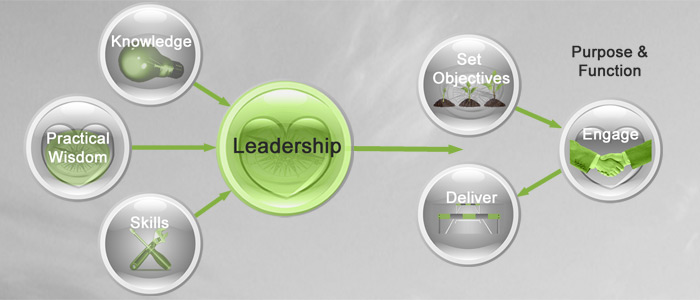
What is leadership? What is the purpose and function of the leader? It is to deliver business growth and is achieved by 1-Set Objectives, 2-Engage & 3-Deliver.
Leadership
Leadership
The sales leader purpose is to deliver business growth and leads both direct and virtual teams to achieve this objective. Leadership is therefore key to business growth success.
Aristotle defined leadership as requiring Knowledge, Skills and Practical Wisdom – the ability to see the good and realize it in a specific situation. All three are necessary and mutually supportive.
Montogomery defined leadership succinctly as:
“The capacity and will to rally men and women to a common purpose and the character which inspires confidence”.
The purpose in an organisation has multiple levels. The company will normally have a vision which states why the company exists and how it will make the world a better place.
The sales team itself has a specific purpose that serves the achievement of this vision and as such will have specific objectives. The sales leader’s overall purpose is to deliver business growth. This is achieved as follows:
- Set achievable but challenging Objectives (or targets) within the context of the vision of the organisation.
- Engage his team to accept these objectives wholeheartedly and in good spirit and then to
- Deliver the performance necessary to achieve these objectives.
Leadership Model
Leadership is not fixed and is dependent on the task at hand. It is also dependent on the type of organisation whether transformational or transactional and on the maturity of the organisation. But I find the following simple model of leadership useful.
A leader requires Knowledge, Skills (&Tools) and Practical Wisdom.
 Practical Wisdom
Knowledge may be learned, Skills may be practiced but Practical Wisdom is grown through through experience and reflection. Practical Wisdom is the ability to see the good and realize it in a specific situation. In other words to decide and do what is effective to achieve the required objectives.
This is not a set of universal rules to be learned or a pocket guide to be drawn upon for the correct solution. It is something only achieved through experience and reflection. It is realized through the ability to relate new experiences to previous experiences, in other words to recognize patterns in situations that facilitate understanding and resolution.
Practical wisdom is supported by the qualities of the leader.
The following list is in a generic order of priority. It is derived from the book “ How to Grow Leaders” by John Adair.
- Enthusiasm. A leader must demonstrate unquenchable enthusiasm for the achievement of the agreed goal.
This may be quiet and slow-burning enthusiasm rather than the heat and fireworks of passion, but it is always there. - Integrity. The quality that engenders trust. Trust is the foundation for all human intercourse.
- Demanding – coupled with Fairness. A leader has high standards and will not compromise on them.
But is also consistent, fair and will not ask of others more than he asks from himself. - Humanity. The raw material with which a leader has to deal with is people and must understand them and go with the grain.
- Confidence. No leader can operate without a quiet confidence.
- Humility. The result of having a proper sense of one’s own limitations.
Its hallmarks are a readiness to listen and to be taught, a willingness to admit when one is wrong, and a reverence for others. - Courage. Demonstrated by doing what is right, because the leader believes it to be right and despite criticism.
 Knowledge & Skills
The knowledge and skills required may be described as:
- (1) situational skills and knowledge i.e. those relating to the particular situation which in this case is sales
- (2) generic leadership skills.
Situational Knowldege and Skills
Good Sales & Marketing knowledge & skills are the most obvious. General Management knowledge & skills enable better empathy and good communication with senior customer executives.
Project Management knowledge & skills enable better management of internal resources, better bid management and better planning. Technical knowledge & skills enable better understanding of products and how they can best be used to solve customer problems.
Skills will be supported by tools such as the sales model which enables:
- Performance monitoring,
- Performance appraisal,
- Close performance gaps through coaching and training.
Leadership Knowledge and Skills
Leadership knowledge & skills include:
- Defining Goals and Objectives
- Planning
- Communication
- Motivation
- Coaching
- Evaluation
- Execution
Purpose & Function
The Purpose of a sales leader is to deliver business growth. This is achieved as with the following functions:
 1 – Set Objectives
A key purpose of a leader is to set objectives that will grow, change and add value to the organisation.
Objectives should not be dictated as they are unlikely to inspire the kind of effort and creativity that produces good results.
Objectives that are negotiated give team members an important sense of goal ownership. And people are naturally more committed to the things they own.
In addition, with this interaction the leader can be sure that the team members have the capacity and the understanding to achieve the objective. Understanding team members will help align objectives and explain them in ways that are motivational.
To set effective objectives a leader must be able to initiate an idea, inform the team and plan to determine if the objectives are feasible.
What are the characteristics of effective objectives? Most experts agree that objectives must be:
- Specific ( Greater as we go down levels. Sales persons objectives are often very specific)
- Clear
- Important (Recognised by team member as important)
- Measurable
- Achievable (But challenging)
- Time-bound (To be achieved in a specific time)
- Aligned (To company Strategy)
- Rewarding (Supported by appropriate awards)
- Ethical
- Resourced
Objectives will be better received by the team if they are perceived to have intrinsic value, to matter,
and to make the world a better place. Ideally the objectives will be aligned to a company vision statement that envisions and communicates a better future.
 2 – Engage
The leader may be required to hire the individuals and build the team. The leader is required to develop the individuals such that their performance improves.
Further, a leader must engage with his team and inspire them to want to deliver a great performance and achieve the assigned objectives.
In the best teams the whole is greater than the sum of the parts. Good morale, team spirit and mutual confidence between the leader and team members is the extra strength that creates a greater whole and inspires a great performance.
To engage his team effectively a leader must be adept at presenting, informing & supporting.
Engagement begins with participative goal setting ideally within the context of a positive and clear company vision statement. This is maintained through motivation, coaching and success. Success is the greatest single factor of good morale. All successes must be communicated.
Motivation is achieved through the application of rewards both intrinsic and extrinsic. Intrinsic rewards produce more intangible forms of recognition such as personal satisfaction, a sense of accomplishment, personal control over one’s work and feeling that one’s work is appreciated. Extrinsic rewards are external, tangible forms of recognition such as bonuses, pay rises, promotion and sales prizes.
- Extrinsic – Financial Rewards
- Bonuses, Commission & Salary Increase.
- Extrinsic – Prestige Rewards
- Increase stature of employees in eyes of colleagues and others
- Intrinsic – Job Content Rewards
- Autonomy (Goal Setting participation, Increased Responsibility, Opportunities to participate in Decision Making),
- Mastery (Grow Professionally and do interesting and important work, Training, Coaching, New Challenge, Working with talented motivated people,
Recognition), - Purpose (Working in a company with a clear Vision, Making a Difference),
- Valued (Trust, Feedback, Coaching, Working in a positive respectful environment,
Working for a Good Boss)
Coaching is used to improve individual performance and to remove performance gaps. Used positively it can maintain and grow engagement as it facilitates individual personal growth.
Within a sales team focus is normally on extrinsic rewards but intrinsic rewards are very important and enable better performance and creativity.
 3 – Deliver
A leader is ultimately judged on what he and his team deliver. How they execute a plan.
To deliver a leader is required to:
- Achieve the task.
- In a sales environment this is normally business growth measured by revenue growth, margin growth, market share growth, customer satisfaction and sales cost.
- Build and develop the team.
- Develop the individual.
The leader uses the sales model to enable him to:
- Monitor performance – Sales process, sales automation and sales management system.
- Appraise performance – Appraisal system.
- Close performance gaps – Coaching and training. Employee development.
- Handle problem employees.
- Remove barriers to performance.
Team members work best when given autonomy to deliver their goals and should know when to ask for help in removing barriers to performance. Identifying barriers to performance may be simple or may involve gathering data and problem analysis before a solution is reached. Barriers to performance often include the requisition of resources from other departments & from higher management to enable progress. They may include the resolution of a resource conflict or an interpersonal conflict.
As stated earlier the sales leader may be required to manage a virtual team in addition to his direct team to create and deliver a proposal to a prospect. Such a project may be complex and project management tools are useful to manage the delivery of a winning proposal on time and to utilise the resources of the company efficiently.
3 Step Plan to Deliver Business Growth
- Step 1: Diagnosis – What are the Business Challenges? What are the growth objectives? What is the current sales and marketing infrastructure and what needs to be provided?
- Step 2: Design – How can Business Growth be achieved? Design the Solution
- Step 3: Implement & Report.
Step 1: Diagnosis
“Diagnose before you Prescribe”. Covey.
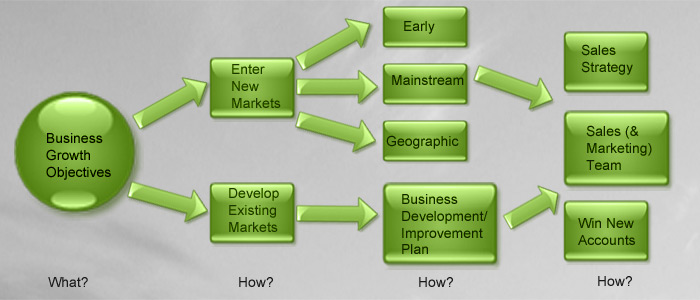
Diagnose Business Challenges to create Solution
If the diagnosis is not correct then the solution may well be inappropriate or incorrect.
What are the Business Challenges?
- What are the Growth Objectives and supporting Business Plan?
- Is New Market Entry required –
- Early (New Products to Market),
- Mainstream (Moving from Early Adopters/Innovators into broader Mainstream market or
- Geographic?
- Is Development of Existing Market required?
- Does a Business Development/Improvement Plan exist?
- Does an acceptable Sales Strategy exist?
- Does a Sales Team exist that is fit for purpose?
- Create, develop or radically improve?
- Is the sales infrastructure sufficient (Hiring Process, Reward System, Sales Process,Sales Management System & Sales Automation system)?
- Is Marketing Support sufficient and integrated with sales (Sales Tools, Sales Training, Lead Generation, Market Coverage)?
- What Major Accounts are required?
- Do references exist?
- Is there sufficient support infrastructure (Tailored Sales Process)?
Step 2: Solution Design
Having diagnosed and agreed the Business Challenges in detail, the Solution may now be designed. Depending on the Business Challenges the Solution will include some or all of the modules.
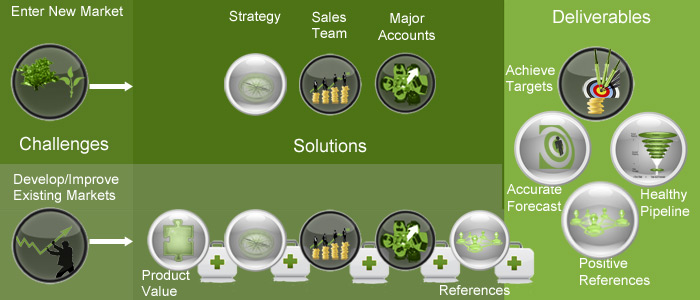
Choose Solution to fit Challenge
- Create Strategy
- Create New Sales Team
- Win New Major Accounts
- Create New Sales Team
- Win New Major Accounts
Sales & Marketing Strategy. This is designed to deliver Business Growth and other Objectives
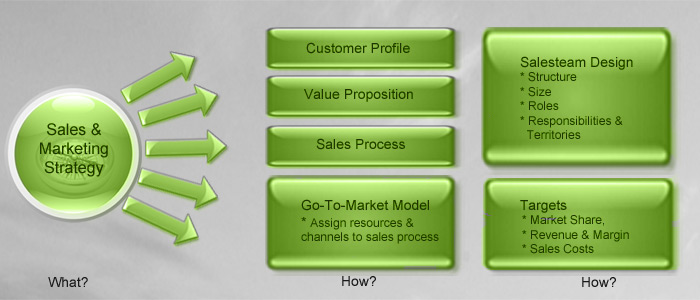
Sales (& Marketing) Strategy
Use information on customer profile, geographic profile, product maturity, the competition and the strength of the vendor to shape the strategy. Develop Value Propositions as required to suit the particular product and customer profile.
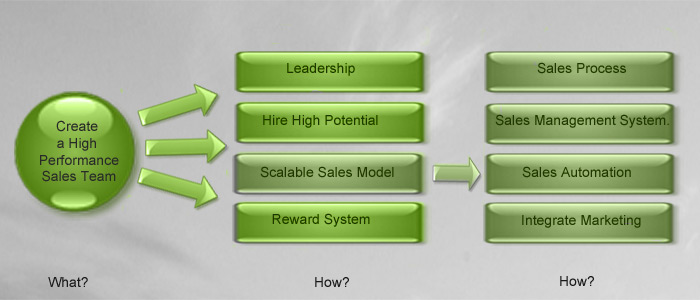
Create a High Performance Sales & Marketing Team
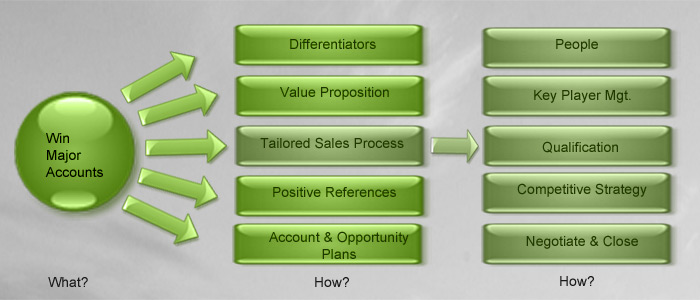
Win Breakthrough Major Accounts
Step 3: Implementation
- Limited Resources
- Immature Infrastructure
- Customer Expectations too high
- Product Development Required
- Solution Development Required
- Partner Management Required
Creating High Performance Sales People
What makes a high performance sales team? What makes a high performance sales person? Can we analyse best practice and use it to improve ordinary sales people? Are relationships important? How important is Value?
To create a high performance sales team it is useful to analyse high performance sales people to understand what makes them successful. Such best practice can then be applied to a scalable sales model that will turn ordinary performers into stars.
Based on research by Sales Performance International and recently Dixon & Adamson in the Harvard Business Review the following was found:
High Performance Salespeople Get the Basics Right
- They work hard & work smart. They put in the hours, prepare well, use tools and training to ensure their efficiency and effectiveness
- They react and solve customer problems . They understand the value of a happy customer as future references and as a source of future business. They have the ability to manage the organisation to deliver the resources to solve the customer problems.
- They build solid relationships. They are honest and deliver on promises and build trust with their customers.
High Performance Salespeople Deliver Value
- Open with Value and Close With Value. Successful salespeople use their deep understanding of their customers’ business to challenge current thinking and to create new solutions to old problems. They have a very clear view of how they can deliver value to the the customer and use this to open and take control of sales conversations. They understand the different concerns of the key players in the buying team. They know that such concerns change throughout the sales cycle and they work had to ensure that such concerns are adequately addressed. Successful salespeople use value as the cornerstone in all phases of the sales cycle and especially during negotiation and close. They understand that it is important to present value in language and models that the customer is comfortable with.
Best Practice Used to Raise Performance of all Salespeople
The most successful high performance sales teams use best practice. They learn from high performing salespeople and use this best practice to create a sales model that is used to turn ordinary sales people into stars.
- Hire Salespeople with High Potential. Sales people with the basics of a good work ethic, good basic relationhip building skills and a desire to win.
- Use Leadership. Building a high performance team in any discipline requires leadership to ensure that the team is focussed and inspired to deliver.
- Use a Scalable Sales Model. This will take all the best practice of the high performance sales people and use it in training and coaching and tools to turn salespeople with high potential into stars. This will include a Sales Process, a Sales Management System, Sales Automation and Marketing Integration. All will combine to improve sales efficiency and effectiveness.
Reward Systems
Three Steps To an Effective Reward System
A Reward System is the most basic communication from Management to its employees and Management need to ensure that what the Reward System is actually saying is what they had wanted to say.
To create an effective reward system it is best to follow three steps:
- Define the required performance
- Convert values, mission statements and strategies into tangible goals
- Convert goals into actions
- Devise comprehensive metrics
- Tracks actions and assessed progress towards goals
- Create financial and nonfinancial reward systems
- Meet employees needs
- Reinforces metrics
- Aligned with company goals
Step 1: Define The Required Performance
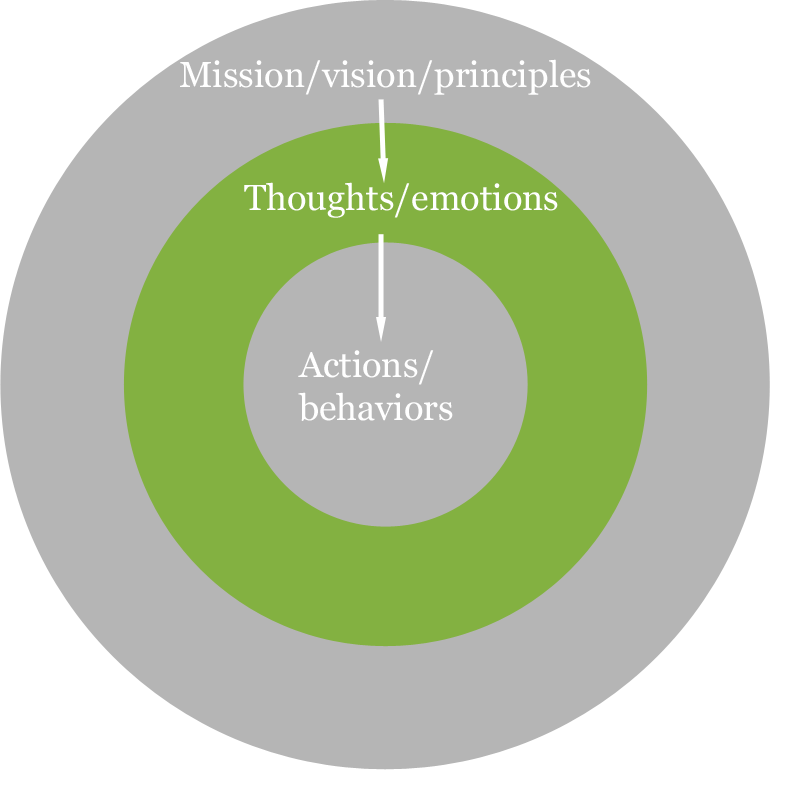 One very effective tool to make visions,missions, goals, and priorities actionable is the bull’s-eye exercise, so named because it is depicted as a three-ringed target as shown. In the outer ring go the goals and initiatives you are trying to make actionable eg customer satisfaction. In the inner-most ring goes the output of the exercise–that is, descriptions of specific employee behaviours that are deemed necessary to achieve the desired outcomes.
- Testing Employee Buy-In to Top Mission/Vision/Principles and how realistic and real they are.
- Creates More Effective Delegation
- Lays the groundwork for more effective organizational processes
Step 2: Devise Comprehensive Metrics
Do not make major changes to the Reward system without first upgrading the metrics to ensure that performance can be measured. The strength of the reward system depends greatly on the competence of the metrics.
“Management gets what it inspects, not what it expects”
If something isn’t measured, you can’t give people feedback about it and they can’t improve.
In designing a competent measurement system there are major tradeoffs:
- Control vs Development
- Performance data can be used for both control and development but not at the same time.
- Rating vs Ranking
- Rating systems compare people (or organizations) to articulated standards
- Pro: Does not hinder teamwork. Gives a company wide view of performance.
- Con: Can enable shirking of evaluation decisions and over time all personnel can end up as high performers according to the rating system whereas in reality they are not.
- Ranking systems compare people not to expressed standards but to other people.
- Pro: Forces Managers to make tough evaluation decisions
- Con: Penalises managers who have overall better staff than another dept. It can discourage teamwork.
Sales Metrics may well be a mixture of rating and ranking. For instance all sales may be on a rating system but also there is a ranking system which offers a prize for top three sales people at the yearly sales management event.
Step 3: Create Reward Systems That Work
“Rewards are anything that increases the probability of a future response”.
Consider money and feedback. Both are good rewards. Offering money to do something increases the likelihood that it will be done. Feedback enables people to systematically improve their performance. But whilst the high performers get most of the money rewards, the low performers tend to get most of the feedback. The key point is that some of the powerful rewards that can be offered are non financial but are often overlooked or discounted by management.
These are also known as intrinsic and extrinsic rewards. Intrinsic rewards produce more intangible forms of recognition such as personal satisfaction, a sense of accomplishment, personal control over one’s work and feeling that one’s work is appreciated. Extrinsic rewards are external, tangible forms of recognition such as bonuses, pay rises, promotion and sales prizes.
A Reward System could and should include Financial (Extrinsic) and Non Financial (Intrinsic) Rewards.
- Extrinsic – Financial Rewards
- Pro: Most people will go to great lengths to get more money
- Con:
- Commodity. Only a limited amount of money to go round. Tricky to administer.
- Does not promote engagement.
- Uncontrollability. Almost all performance measures contain some level of uncontrollability i.e. outside the control of the team member.
- Interdependency. Most outcomes are the result of work by many people. How much was done by the team member.
- May stunt creativity and team work for complex tasks.
- Extrinsic – Prestige Rewards
- Increase stature of employees in eyes of colleagues and others
- Pro: Cost effective. Not a commodity. Can bind employee to company
- Con: May not be valued by all. Scarcity of Rewards.
- Intrinsic – Job Content Rewards
- Include Clear Feedback, Increased Responsibility, New Challenge, Trust, Recognition, Autonomy, Opportunities to participate in Decision Making, Grow Professionally and do interesting and important work, working in a positive respectful environment, working with talented motivated people, working in a company with a clear vision, working for a good boss.
- Pro: Unlimited availability. Engages team.
- Con: Not much. Can sometimes be taken for granted.
A good reward system has key components:
- Availability & Eligibility
- Eligibility is intentional unavailability
- May only be available to certain categories of people. Motivates people to climb the organizational ladder
- Visibility
- Must be visible at a minimum to those who receive rewards
- Contingent on Performance
- Rewards should be based more on performance than on seniority, titles or organizational membership.
- Timeliness
- To be maximally effective, rewards should be received soon after the reward-worthy action has occurred.
- Reversibility
- Ideally should be able to take back a reward you shouldn’t have given
- Or at a minimum the recipient should not get it again
- Dangers of rewards being taken for granted