Archive for the ‘Win New Major Accounts’ Category
The Art of Persuasion
Communication is a fundamental part of business and personal life. We now have many different ways of communicating from face to face to phones, social media, print media and broadcast media.
With all of these communication channels we are trying to inform, persuade, motivate, coach and manage relationships.
I would like to review a very important element of commuication: the art of persuasion. And I will limit my focus to B2B communication (mainly).
Win:Win Framework
Communication is always within a context or framework which may be implicit or explicit.
For some the word persuasion has ominous undertones and a worry about being manipulated.
I am assuming, in this discussion, that persuasion is used within a framework that assumes a (win: win) or positive outcome for both parties.
I assume that what I am persuading the customer to do will add value to the customer’s business and result in a (win: win) transaction.
Basic Persuasion Model
A basic persuasion model was constructed by Aristotle and consists of three elements:-
- Credibility – relates to the character and reputation of the persuader.
- Emotion or Empathy – the persuader must have the the ability to identify and understand the other person’s feelings, ideas and situation.
- Logic – relates directly to the logic of the argument.
Appealing to Credibility
In appealing to credibility, both the individual and the company he represents must be credible in the eyes of the audience. He must emit true sincerity.
Genuine sincerity means that you actually care about someone’s problems or concerns. It creates a certain amount of trust. And trust is the foundation of relationships.
The company builds its credibility on its successes and on its third party references. (In the B2B mainstream market (Early & Late Majority) positive references are key to credibility.)
The individual builds his individual credibility with integrity, historical success (supported by knowledge), skills and experience (as required by the audience). Initially the company brand will lend credibility to the individual but the individual must build and maintain his own over time.
In launching new products the phrase “Credibility before Visibility” is very apt. A lot of marketing and sales expense may be wasted in persuading the market to buy products that are not yet credible in the eyes of the target audience.
Appealing to Emotion
This using your heart as well as your head. It’s the ability to read emotions in others. It’s being able to experience from another person’s perspective. It is empathy.
It appeals to the emotions, imagination and self interest in the audience. In some cases to feel what the presenter feels.
The message evoking an emotional response may be delivered by words, messages but also by non verbal communication. The words may well be in the form of a story, a vision that transports the audience to understand the presenter’s point of view or to join him in envisioning the a particular part of the world as improved or as a better place. Music, colours, films, graphics etc. may be used to emphasize and communicate the required message.
Non verbal communication can give wither a positive or negative response. Such communication is delivered via facial expression, eye contact, gestures, posture and body orientation, humour, proximity, paralinguistics (tone, pitch, rhythm, timbre, loudness and inflection of voice), dress sense, attitude & confidence.
Emotion also includes building a relationship and a rapport that can reduce barriers to communication and engender trust which is a foundation of all human intercourse.
Appealing to Logic
Persuasion Techniques
Whilst techniques can be used to persuade they are most effective when supported by the persuasion model above. These techniques include structure, body language, speech, maintaining attention and the darker arts of weapons of influence.
Structure
- Introduction – Frame the topic. Prepare audience to be receptive.
- Narrative – a story in a form that is relevant to the audience that tells what you want them to do.
- Argument – proofs and supporting logic.
- Refutation – anticipate objections to the argument.
- Conclusion – appeal to the audience for understanding, its action and its approval.
Body Language
- Facial expressions
- Gestures
- Open or Closed Body Signals
- Spatial relationships – how close we are to our audience.
Speech
- Volume
- Rate of Speaking
- Tone, pitch and inflection.
Maintain Attention
If the audience is not paying attention you are not communicating, there is no communication and no persuasion can occur. Attention is best if it rises over time.
Most people have short attention spans.
Make the message memorable and understood.
- Say what you’re going to say. Say it.Say what you said.
- Keep it short 15 mins is optimal.
- Avoid distractions, interruptions and breaks
- Avoid large disagreements to what you say by ensuring that key members of the audience have been persuaded before the presentation.
Weapons of Influence
We have automatic behavior patterns that we use to simplify the modern world and enable action and void being frozen by too much analysis. These behaviour patterns make us vulnerable to persuasion by those who know how they work. These weapons of persuasion are part of thee dark arts of persuasion in that they do not always result in a win:win situation if used unscrupulously. In B2B selling , professional buying processes are designed to minimize or remove the impact of these weapons but they are used often in B2C selling.
We live in an extraordinarily complex and stimulated environment, easily the most rapidly moving and complex that has ever existed. To deal with it we need shortcuts. We can’t be expected to recognize and analyze all the aspects in each person, event and situation we encounter in even one day. We haven’t the time, energy or capacity for it. Instead, we must often use our stereotypes, our rules of thumb to classify things according to a few key features and then to respond mindlessly when one or another of these trigger features is present. Sometimes the behaviour will not be appropriate for the situation. But we expect the imperfection since the alternative is that we would be left frozen, analyzing and miss the time for action.
According to Alfred North Whitehead “civilization advances by extending the number of operations we can perform without thinking about them”. These are the key weapons.
- Reciprocity – “One good turn deserves another…”
- People are more likely to give to you if you have already given to them
- Commitment & Consistency – “Stay on course!”
- We have a nearly obsessive desire to be consistent with what we have already done.
- If I can get you to make a commitment (that is to take a stand, go on record), I will have set the stage for your automatic and ill-considered with that commitment. Once a stand is taken, there is a natural tendency to behave in ways that are stubbornly consistent with the stand.
- People are more likely to behave the way you want them to behave if they believe that this behaviour is consistent with an existing commitment
- Social proof – “Monkey see, monkey do”
- People are more likely to follow a particular course of action if they see other people doing the same thing
- Authority –
- People are more willing to follow instructions if the perceive the instructor to have authority or expertise
- Likeability – “Jobs for the boys”
- People give preferential treatment to those that they know and like
- Scarcity
- Rare items and opportunities are much more attractive than commonplace equivalents.
Fail to Plan, Plan to Fail

Plans - Improve effectiveness and efficiency. Don't waste time.
Plans improve Effectiveness and Efficiency
Effort spent in planning will reap rewards in sales effectiveness and efficiency.
Planning tools include Territory Plans , Account Plans & Opportunity Plans. These plans are most effective if stored on a Sales Automation system to ensure that the information is retained and communicated as required.
Territory Plan
A Territory Plan focuses on the segmentation of accounts and opportunities in a defined territory in order to prioritize which ones in which to invest sales resources. It will normally include:
- Customer Profile and Qualification Criteria
- Market Analysis
- Segment Accounts by Business Potential and Current Business Relationship
- Alpha High Future Business Potential – prioritised by level of current relationship
- Beta – Moderate to Low Business Potential, high level of Current Relationship
- Delta – Little or no near term Business Potential, insufficient data to accurately assess potential, low level of current relationship
- Territory coverage strategy
- Messaging Strategy
- Resources allocated to Alpha, Beta and Delta accounts.
Account Plan
- Account Profile
- Company, Financials, Offerings, Market Analysis, Competition, Exec Biogs, Likely Business Issues, Potential Capabilities Required
- Install Base
- Recurring Revenues
- Customer Satisfaction levels
- Recent Projects
- Key Player List Summary
- Account Team & Coverage Summary
- Current Initiatives/Projects happening inside the Account
- White Space & Share of Wallet analysis
- Current & Future Opportunities
- Total Opportunity Portfolio
- Action Plan
- Resource Plan
Opportunity Plan
Each Opportunity will have its own plan. The size of the plan will be in relation to the size of the opportunity. It will normally include:
- Business Pain/Issue
- Value Proposition
- Customer Rules
- Analysis & Presentation
- Is it compelling?
- Key Player List
- Coverage strategy
- Access to key personnel?
- Qualification Status
- Solution Creation status
- Evaluation Plan /Buying Process
- Competitive Strategy
- Analysis of Strength and Position
- Negotiation & Close Strategy
- Implementation Plan
Using Value to Sell Complex Services
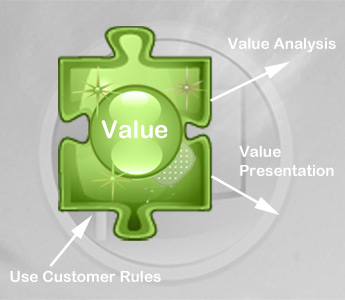
Value must be recognised by the customer - use his rules.
Selling Complex Services
Services are invisible, intangible so how best to sell them?
By describing clearly the value that they can bring to the customer.
This is done by estimating the value to the customer, the investment required and describing how a customer reference has received similar value .
Value Proposition
The delivery vehicle for communicating value is known as a value proposition and can be used for all kinds of sale but is particularly useful for complex services sales.
It is normally used initially in prospecting to get the attention of an executive and to get agreement from him to assign resources to work together on an evaluation plan. This will include the creation of a detailed business plan to ensure that it is the right decision for the company.
Simple Example
A very simple value proposition example using the services offered by O’Brien Business Solutions is shown below.
We believe that Customer A should be able to
- Achieve Business Growth by a minimum of 15% in the next year
Through an ability to:
- Launch New Products and Services
- Create a New High Performance Sales Team
- Win New Breakthrough major Accounts & create positive references
- a Business Solution designed and implemented to deliver delivering Sales and Marketing programmes.
- £YK.
- an 1 year contract and a start within 2 weeks.
- a similar Business Solution to Customer Reference A where a Business Growth of 20% was achieved in the same timeframe.
A more complicated BPO example
We believe that Company A should be able to
- Increase efficiency by 10% resulting in a 5% increase in profits per annum.
- With an upside of
- Improve knowledge sharing, security and workforce effectiveness
Through the ability to
- Design and implement new business processes using the latest technology
As a result of
- Outsourcing specific document intensive processes in HR, Legal & Supply Chain departments
For an investment of
- Set up – £XM set up
- Ongoing – Annual Service charge of £YM
Based on the following Assumptions
- 5 Year contract
- Set up in Yr 1
- Relevant staff transferred according to TUPE.
- Benefits realized in years 2-5.
Best relationships are based on value
Value is referenced throughout the sale. It may well start with a straw-man, built using data from a previously successful customer or reference and extrapolated to address this particular customer. It will be developed as the sale proceeds as more detail on the solution is developed and information on the assumptions is discovered. In some cases, some pilots may need to be implemented to test some key assumptions in the value equation.
The best relationships in business have the delivery of value as their foundation. A sales person that is perceived to consistently deliver value (advice, information, solutions) will be better placed to form better relationships.
Value flows throughout the organisation
For instance the CEO may have an objective of increasing the average revenue per user. This will be come a lead generation objective by the marketing department and an opportunity conversion objective by sales. A Value chain may be created to move from clearly known objectives at the top of the organisation to create new ones lower down the organisation.
Selling Complex Services into the Early Market
Selling into the Early Market is characterised by no or very limited customer references that will underpin the value proposition.
Whilst the Early Market is also characterised by buyers that are more innovative and as such prepared to take a risk, they do need some rationale for taking a decision to proceed.
Services do have more difficulties here than say selling a product like a piece of equipment in that a piece of equipment can be tested by a third party and the benefits verified.
Complex services such as BPO require at least one customer reference before the value proposition mat be truly verified. And as such it underlines how important the customer references are and therefore it is worth the company putting a lot of resources into obtaining the first contract an delivering it. It is worth noting also that it will take time before the benefits can be calculated and therefore will take time before the contract can become a true customer reference.
What can be done in the absence of a customer reference? A number of options can be explored:
- Start with a good relationship and trust as a foundation?
- Can you use process that is being done inside (selling) company’s own organisation?
- Does the new process utilize a core competence of the (selling) company? For instance a new technology that will improve the process. Examine its use in customer processes and obtain results.
- Utilize Market research to verify the value proposition.
There are two methods to achieving the market research:
- Find market research by a respected third party that will verify the claims made in the value proposition.
- If adequate market research is not available then conduct bespoke market research that will verify the claims made in the value proposition.
Lead with Value, Close with Value
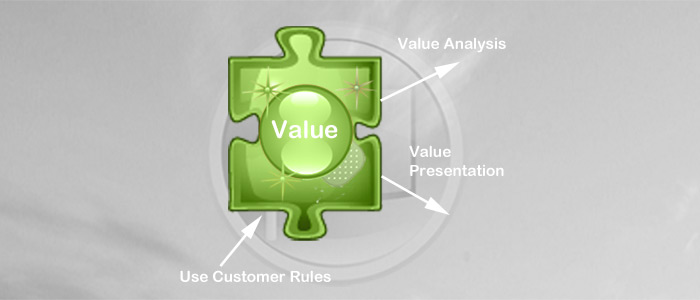
Best Relationships are based on Value
Best practice dictates the sale is opened, driven and closed with Value. Value must be described in terms that are relevant to the customer. The Value proposition normally includes (i) the delivery of a tangible customer goal, or the resolution of a customer issue or pain in clear quantifiable terms (ii) for an acceptable investment. Or in other words: Value = Total Benefits – Total Investment.
An example:-
” We believe that Company A should be able to
- Increase Average Revenue Per User from £22 per month to £26 per month resulting in an increase in profits of £5M per annum within the first year.
Through the ability
- To offer new data services
As a result of
- A network expansion and the creation and launch of a new data service
For an investment of
- £3M.
Based on the following Assumptions
- 3 new Network Nodes costing £2M.
- Network Management System £500K.
- Marketing Plan costing £500K.”
Value is referenced throughout the sale. It may well start with a straw-man, built using data from a previously successful customer or reference and extrapolated to address this particular customer. It will be developed as the sale proceeds as more detail on the solution is developed and information on the assumptions is discovered. In some cases, some pilots may need to be implemented to test some key assumptions in the value equation.
The best relationships in business have the delivery of value as their foundation. A sales person that is perceived to consistently deliver value (advice, information, solutions) will be better placed to form better relationships.
A Goal/Objective for the CEO flows down to the CMO and down to the marketing department.
For instance the CEO may have an objective of increasing the average revenue per user. This will be come a lead generation objective by the marketing department and an opportunity conversion objective by sales. A Value chain may be created to move from clearly known objectives at the top of the organisation to create new ones lower down the organisation.