Sales Leadership
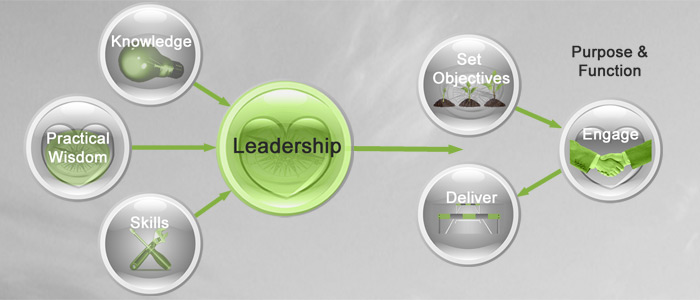
What is leadership? What is the purpose and function of the leader? It is to deliver business growth and is achieved by 1-Set Objectives, 2-Engage & 3-Deliver.
Leadership
Leadership
The sales leader purpose is to deliver business growth and leads both direct and virtual teams to achieve this objective. Leadership is therefore key to business growth success.
Aristotle defined leadership as requiring Knowledge, Skills and Practical Wisdom – the ability to see the good and realize it in a specific situation. All three are necessary and mutually supportive.
Montogomery defined leadership succinctly as:
“The capacity and will to rally men and women to a common purpose and the character which inspires confidence”.
The purpose in an organisation has multiple levels. The company will normally have a vision which states why the company exists and how it will make the world a better place.
The sales team itself has a specific purpose that serves the achievement of this vision and as such will have specific objectives. The sales leader’s overall purpose is to deliver business growth. This is achieved as follows:
- Set achievable but challenging Objectives (or targets) within the context of the vision of the organisation.
- Engage his team to accept these objectives wholeheartedly and in good spirit and then to
- Deliver the performance necessary to achieve these objectives.
Leadership Model
Leadership is not fixed and is dependent on the task at hand. It is also dependent on the type of organisation whether transformational or transactional and on the maturity of the organisation. But I find the following simple model of leadership useful.
A leader requires Knowledge, Skills (&Tools) and Practical Wisdom.
 Practical Wisdom
Knowledge may be learned, Skills may be practiced but Practical Wisdom is grown through through experience and reflection. Practical Wisdom is the ability to see the good and realize it in a specific situation. In other words to decide and do what is effective to achieve the required objectives.
This is not a set of universal rules to be learned or a pocket guide to be drawn upon for the correct solution. It is something only achieved through experience and reflection. It is realized through the ability to relate new experiences to previous experiences, in other words to recognize patterns in situations that facilitate understanding and resolution.
Practical wisdom is supported by the qualities of the leader.
The following list is in a generic order of priority. It is derived from the book “ How to Grow Leaders” by John Adair.
- Enthusiasm. A leader must demonstrate unquenchable enthusiasm for the achievement of the agreed goal.
This may be quiet and slow-burning enthusiasm rather than the heat and fireworks of passion, but it is always there. - Integrity. The quality that engenders trust. Trust is the foundation for all human intercourse.
- Demanding – coupled with Fairness. A leader has high standards and will not compromise on them.
But is also consistent, fair and will not ask of others more than he asks from himself. - Humanity. The raw material with which a leader has to deal with is people and must understand them and go with the grain.
- Confidence. No leader can operate without a quiet confidence.
- Humility. The result of having a proper sense of one’s own limitations.
Its hallmarks are a readiness to listen and to be taught, a willingness to admit when one is wrong, and a reverence for others. - Courage. Demonstrated by doing what is right, because the leader believes it to be right and despite criticism.
 Knowledge & Skills
The knowledge and skills required may be described as:
- (1) situational skills and knowledge i.e. those relating to the particular situation which in this case is sales
- (2) generic leadership skills.
Situational Knowldege and Skills
Good Sales & Marketing knowledge & skills are the most obvious. General Management knowledge & skills enable better empathy and good communication with senior customer executives.
Project Management knowledge & skills enable better management of internal resources, better bid management and better planning. Technical knowledge & skills enable better understanding of products and how they can best be used to solve customer problems.
Skills will be supported by tools such as the sales model which enables:
- Performance monitoring,
- Performance appraisal,
- Close performance gaps through coaching and training.
Leadership Knowledge and Skills
Leadership knowledge & skills include:
- Defining Goals and Objectives
- Planning
- Communication
- Motivation
- Coaching
- Evaluation
- Execution
Purpose & Function
The Purpose of a sales leader is to deliver business growth. This is achieved as with the following functions:
 1 – Set Objectives
A key purpose of a leader is to set objectives that will grow, change and add value to the organisation.
Objectives should not be dictated as they are unlikely to inspire the kind of effort and creativity that produces good results.
Objectives that are negotiated give team members an important sense of goal ownership. And people are naturally more committed to the things they own.
In addition, with this interaction the leader can be sure that the team members have the capacity and the understanding to achieve the objective. Understanding team members will help align objectives and explain them in ways that are motivational.
To set effective objectives a leader must be able to initiate an idea, inform the team and plan to determine if the objectives are feasible.
What are the characteristics of effective objectives? Most experts agree that objectives must be:
- Specific ( Greater as we go down levels. Sales persons objectives are often very specific)
- Clear
- Important (Recognised by team member as important)
- Measurable
- Achievable (But challenging)
- Time-bound (To be achieved in a specific time)
- Aligned (To company Strategy)
- Rewarding (Supported by appropriate awards)
- Ethical
- Resourced
Objectives will be better received by the team if they are perceived to have intrinsic value, to matter,
and to make the world a better place. Ideally the objectives will be aligned to a company vision statement that envisions and communicates a better future.
 2 – Engage
The leader may be required to hire the individuals and build the team. The leader is required to develop the individuals such that their performance improves.
Further, a leader must engage with his team and inspire them to want to deliver a great performance and achieve the assigned objectives.
In the best teams the whole is greater than the sum of the parts. Good morale, team spirit and mutual confidence between the leader and team members is the extra strength that creates a greater whole and inspires a great performance.
To engage his team effectively a leader must be adept at presenting, informing & supporting.
Engagement begins with participative goal setting ideally within the context of a positive and clear company vision statement. This is maintained through motivation, coaching and success. Success is the greatest single factor of good morale. All successes must be communicated.
Motivation is achieved through the application of rewards both intrinsic and extrinsic. Intrinsic rewards produce more intangible forms of recognition such as personal satisfaction, a sense of accomplishment, personal control over one’s work and feeling that one’s work is appreciated. Extrinsic rewards are external, tangible forms of recognition such as bonuses, pay rises, promotion and sales prizes.
- Extrinsic – Financial Rewards
- Bonuses, Commission & Salary Increase.
- Extrinsic – Prestige Rewards
- Increase stature of employees in eyes of colleagues and others
- Intrinsic – Job Content Rewards
- Autonomy (Goal Setting participation, Increased Responsibility, Opportunities to participate in Decision Making),
- Mastery (Grow Professionally and do interesting and important work, Training, Coaching, New Challenge, Working with talented motivated people,
Recognition), - Purpose (Working in a company with a clear Vision, Making a Difference),
- Valued (Trust, Feedback, Coaching, Working in a positive respectful environment,
Working for a Good Boss)
Coaching is used to improve individual performance and to remove performance gaps. Used positively it can maintain and grow engagement as it facilitates individual personal growth.
Within a sales team focus is normally on extrinsic rewards but intrinsic rewards are very important and enable better performance and creativity.
 3 – Deliver
A leader is ultimately judged on what he and his team deliver. How they execute a plan.
To deliver a leader is required to:
- Achieve the task.
- In a sales environment this is normally business growth measured by revenue growth, margin growth, market share growth, customer satisfaction and sales cost.
- Build and develop the team.
- Develop the individual.
The leader uses the sales model to enable him to:
- Monitor performance – Sales process, sales automation and sales management system.
- Appraise performance – Appraisal system.
- Close performance gaps – Coaching and training. Employee development.
- Handle problem employees.
- Remove barriers to performance.
Team members work best when given autonomy to deliver their goals and should know when to ask for help in removing barriers to performance. Identifying barriers to performance may be simple or may involve gathering data and problem analysis before a solution is reached. Barriers to performance often include the requisition of resources from other departments & from higher management to enable progress. They may include the resolution of a resource conflict or an interpersonal conflict.
As stated earlier the sales leader may be required to manage a virtual team in addition to his direct team to create and deliver a proposal to a prospect. Such a project may be complex and project management tools are useful to manage the delivery of a winning proposal on time and to utilise the resources of the company efficiently.