Business Consultancy? What does it offer…

A Good Business Consultant delivers Business Improvement
What do Good Business Consultants do?
- They improve business performance
- They deliver tangible results
- They relentlessly seek to deliver tangible value
What are the Problems with Business Consultants?
Question: What does a consultant do if you ask him the time?
Answer: He asks to borrow your watch, he tells you the time and then walks off with your watch.
The word consultant does have some baggage, basically because it has become a term that has been used too much to mean too many things ….some of them negative. And without a well known brand name behind it the negative baggage may come to the fore.
It is associated in some minds with many initiatives that delivered few quantifiable benefits. It is associated with high costs and sometimes with a lack of drive, initiative and creativity.
And of course unlike a doctor or a lawyer, anyone can call themselves a consultant.
Without the support of a well known consultancy brand then some of the negative market perceptions of Business Consultancy may dominate in the mind of a prospective customer and a focus on value becomes even more essential.
I have asked some questions below to answer a few questions that may explain the benefits that good business consultants can offer.
What Areas do they Work in?
- Management Consulting 16% ( Operations Management(inc. Sales& Marketing) 43%, Strategy 31%,HR 20%, IT strategy & planning 6%)
- IT Outsourcing 36%
- Business Process Outsourcing 28%
- Systems Integration 20%
Why do Clients Hire them?
- People needs
- Specialist skills or a level of knowledge they lack internally
- Thinking needs
- A different perspective
- Gather and analyse data to back up perspective
- Challenge long term assumptions
- Process and technology needs
- Transferring an idea into reality
- Provide best practice and thought leadership
- Provide the focus the deliver on time and to budget
How do they Deliver Business Improvement ?
- Specialist Projects
- Utilize specialist knowledge
- Integrated Solutions
- Large scale change
- Strategic Advice
- Generate business insight
- Focus on advisory work rather than implementation
What Business Improvement do they deliver?
- Improve effectiveness – getting the desired result (doing the right thing)
- Improve efficiency – getting it quickly (doing the thing right)
- Delivered with economy – getting it at a reasonable market rate
- Smaller firms with the right specialist knowledge, experience and tools can offer economy and flexible engagement models.
What kind of Consultancy Firms are there?
- Traditional Delivery (Almost all skills in house)
- Relationship
- e.g. Mc Kinsey, Bain. Mainly focussed on effectiveness projects such as strategy advice
- Product
- e.g. Simon-Kucher. Top line growth through advising on pricing and marketing.
- Hub & Spoke Delivery (Hub with brand, support and winning business with spoke as associates/partners for delivery)
- Broker Firms
- e.g. Eden McCallum. Cope well with variable income stream with variable cost base. They co-ordinate the resources necessary to deliver a broad range of consulting services to clients
- Diversifying Firms
- e.g. Xerox. Company with historical product heritage and use it a launch pad into the world of professional services.
- Integrator ( Prime contractor managing subcontractors/partners as required)
- Transformation Firms
- e.g. IBM/Accenture. Moving from transactions to transformation. Requires (1) scale to deliver results – organizational and financial. (2) Depth of knowledge and (3) correct fusion of business(consulting & outsourcing) and technology. Is about long term continuous improvement and relationships.
- Transaction Firms
- e.g. CapGemini,LogicaCMG,EDS. Small number of large deals focussed on on large scale systems delivery or outsourcing. Tend to be one off deals rather than continuous.
What does a Good Consultant offer?
- Relentless effort to increase value for customers
- Trust
- Specialist knowledge
- And continuous learning to maintain knowledge
- Breadth of Experience
- Perspective
- Good interpersonal & communication skills and an ability to inspire trust
- Development of case histories, best practice and tools
- Thought Leadership (truely original or at least original to the organisation..most customers are happy with ideas that are pragmatic and have well defined case histories that demonstrate tangible value delivered.)
- Ability to manage projects that will deliver tangible business improvement
What is the Best Method of Promoting Business Consultancy?
Lead with Value
It is better that they lead with the tangible value that they can deliver very clearly as otherwise they will not brand themselves positively in the mind of the prospective audience. Without the support of a well known consultancy brand then this approach becomes essential as some of the negative market perceptions of Business Consultancy may dominate.
Fail to Plan, Plan to Fail

Plans - Improve effectiveness and efficiency. Don't waste time.
Plans improve Effectiveness and Efficiency
Effort spent in planning will reap rewards in sales effectiveness and efficiency.
Planning tools include Territory Plans , Account Plans & Opportunity Plans. These plans are most effective if stored on a Sales Automation system to ensure that the information is retained and communicated as required.
Territory Plan
A Territory Plan focuses on the segmentation of accounts and opportunities in a defined territory in order to prioritize which ones in which to invest sales resources. It will normally include:
- Customer Profile and Qualification Criteria
- Market Analysis
- Segment Accounts by Business Potential and Current Business Relationship
- Alpha High Future Business Potential – prioritised by level of current relationship
- Beta – Moderate to Low Business Potential, high level of Current Relationship
- Delta – Little or no near term Business Potential, insufficient data to accurately assess potential, low level of current relationship
- Territory coverage strategy
- Messaging Strategy
- Resources allocated to Alpha, Beta and Delta accounts.
Account Plan
- Account Profile
- Company, Financials, Offerings, Market Analysis, Competition, Exec Biogs, Likely Business Issues, Potential Capabilities Required
- Install Base
- Recurring Revenues
- Customer Satisfaction levels
- Recent Projects
- Key Player List Summary
- Account Team & Coverage Summary
- Current Initiatives/Projects happening inside the Account
- White Space & Share of Wallet analysis
- Current & Future Opportunities
- Total Opportunity Portfolio
- Action Plan
- Resource Plan
Opportunity Plan
Each Opportunity will have its own plan. The size of the plan will be in relation to the size of the opportunity. It will normally include:
- Business Pain/Issue
- Value Proposition
- Customer Rules
- Analysis & Presentation
- Is it compelling?
- Key Player List
- Coverage strategy
- Access to key personnel?
- Qualification Status
- Solution Creation status
- Evaluation Plan /Buying Process
- Competitive Strategy
- Analysis of Strength and Position
- Negotiation & Close Strategy
- Implementation Plan
Using Value to Sell Complex Services
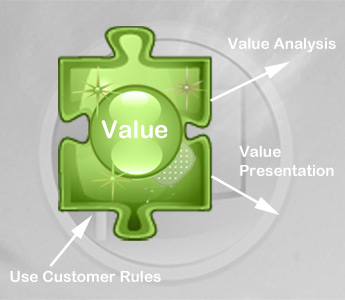
Value must be recognised by the customer - use his rules.
Selling Complex Services
Services are invisible, intangible so how best to sell them?
By describing clearly the value that they can bring to the customer.
This is done by estimating the value to the customer, the investment required and describing how a customer reference has received similar value .
Value Proposition
The delivery vehicle for communicating value is known as a value proposition and can be used for all kinds of sale but is particularly useful for complex services sales.
It is normally used initially in prospecting to get the attention of an executive and to get agreement from him to assign resources to work together on an evaluation plan. This will include the creation of a detailed business plan to ensure that it is the right decision for the company.
Simple Example
A very simple value proposition example using the services offered by O’Brien Business Solutions is shown below.
We believe that Customer A should be able to
- Achieve Business Growth by a minimum of 15% in the next year
Through an ability to:
- Launch New Products and Services
- Create a New High Performance Sales Team
- Win New Breakthrough major Accounts & create positive references
- a Business Solution designed and implemented to deliver delivering Sales and Marketing programmes.
- £YK.
- an 1 year contract and a start within 2 weeks.
- a similar Business Solution to Customer Reference A where a Business Growth of 20% was achieved in the same timeframe.
A more complicated BPO example
We believe that Company A should be able to
- Increase efficiency by 10% resulting in a 5% increase in profits per annum.
- With an upside of
- Improve knowledge sharing, security and workforce effectiveness
Through the ability to
- Design and implement new business processes using the latest technology
As a result of
- Outsourcing specific document intensive processes in HR, Legal & Supply Chain departments
For an investment of
- Set up – £XM set up
- Ongoing – Annual Service charge of £YM
Based on the following Assumptions
- 5 Year contract
- Set up in Yr 1
- Relevant staff transferred according to TUPE.
- Benefits realized in years 2-5.
Best relationships are based on value
Value is referenced throughout the sale. It may well start with a straw-man, built using data from a previously successful customer or reference and extrapolated to address this particular customer. It will be developed as the sale proceeds as more detail on the solution is developed and information on the assumptions is discovered. In some cases, some pilots may need to be implemented to test some key assumptions in the value equation.
The best relationships in business have the delivery of value as their foundation. A sales person that is perceived to consistently deliver value (advice, information, solutions) will be better placed to form better relationships.
Value flows throughout the organisation
For instance the CEO may have an objective of increasing the average revenue per user. This will be come a lead generation objective by the marketing department and an opportunity conversion objective by sales. A Value chain may be created to move from clearly known objectives at the top of the organisation to create new ones lower down the organisation.
Selling Complex Services into the Early Market
Selling into the Early Market is characterised by no or very limited customer references that will underpin the value proposition.
Whilst the Early Market is also characterised by buyers that are more innovative and as such prepared to take a risk, they do need some rationale for taking a decision to proceed.
Services do have more difficulties here than say selling a product like a piece of equipment in that a piece of equipment can be tested by a third party and the benefits verified.
Complex services such as BPO require at least one customer reference before the value proposition mat be truly verified. And as such it underlines how important the customer references are and therefore it is worth the company putting a lot of resources into obtaining the first contract an delivering it. It is worth noting also that it will take time before the benefits can be calculated and therefore will take time before the contract can become a true customer reference.
What can be done in the absence of a customer reference? A number of options can be explored:
- Start with a good relationship and trust as a foundation?
- Can you use process that is being done inside (selling) company’s own organisation?
- Does the new process utilize a core competence of the (selling) company? For instance a new technology that will improve the process. Examine its use in customer processes and obtain results.
- Utilize Market research to verify the value proposition.
There are two methods to achieving the market research:
- Find market research by a respected third party that will verify the claims made in the value proposition.
- If adequate market research is not available then conduct bespoke market research that will verify the claims made in the value proposition.
Web 2.0
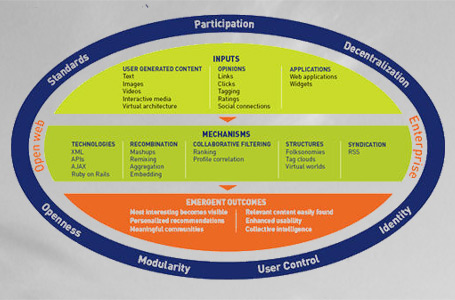
Web 2.0 Framework
Web 2.0 is a convergence of social and business practices rather than a technology transition. In fact many of the technologies that make up Web 2.0 were available during the early 90s.
The elements that make up Web 2.0 are as follows:
- User-generated content
- Rich Internet applications (RIA)
- Social Networking
- Cloud Computing
- Web-centric development and architecture models
- Data
- Mashups
- Scale free and long tail
- Mobility
In a little more detail:
- User-generated content: Wikis, Blogs, Communities, Photos eg Flickr, Videos eg YouTube Collaboration and Collaborative Technologies
- Rich Internet Applications: Practices, Technologies and Frameworks.
- Techologies include: HTML, HTTP, CSS, Javascript, AIR, Silverlight, XHTML, Ajax, JSON,
- Frameworks: JQuery, RubyonRails (RoR), Dojo, Yahoo Widgets, Google Gadgets.
- Social Networks: Facebook, Myspace, Twitter, LinkedIn, Friendster, Ning, Jive, Socialtext, Awareness, Google, Microsoft, IBM, Social Networking standards and interfaces.
- Cloud Computing: Compute and storage infrastructures are available to use as utility rather than within one’s own infrastructure. Can include computer hardware, platform service and complete applications (eg Salesforce.com) as an external service.
- Web-centric development and architecture models: |Web 2.0 provides a different way of building applications.. Applications are hosted with a fast feature velocity (ie features added much quicker timeframe – days rather than months), use development methods such as agile and scrum, have massive scalability, use frameworks such as Mapreduce, Hadoop and BigTable and use interfaces such as JSON and REST.
- Data: Content Aggregation, Syndication and Federation via RSS and Atom. Analytics. Trending towards Semantic Web and Web 3.0.
- Mashups:Web apps are increasingly becoming mashups where content is combined, annotated and aggregated from different sources.
- Scale Free and Long Tail: The Applications are scale-free. Websites must cope with peaks in usage and must not crash under the occasional heavy load. The long tail is the concept that. although there are some products (eg new books, music, movies)that are popular and sell a large number of single products, there are also smaller markets that prefer many related products that are rare or less well known.
- Mobility: Mobile phones , Tablets and mobile phone networks have become pervasive and all powerful.
Lead Generation Terminology
Target Market
The Target Market or Target Market segment is a list of companies (B2B) or consumers (B2C) that possess the required buyer profile that make them pre-disposed to buy the product.
Territory
A territory is a part of the target market which has been allocated to a sales person or sales team.
A Lead
A lead is a potential opportunity sometimes known as a prospect – For example, a person met at a conference who expressed interest, or someone who filled out a form on the company website.
Lead Conversion (Or Qualification)
If the lead is qualified and the salesperson and decides to pursue it, the lead is “converted,” and becomes an opportunity. ( Note that the term conversion is used somewhat loosely and in many cases in Digital Marketing does not end up with an opportunity but with a (more qualified) lead that still requires further qualification before it becomes an opportunity.
An Opportunity
Opportunities are the sales and pending deals that are tracked in that Sales Pipeline or Funnel. The pipeline is built by adding more opportunities will contribute to the forecast.
Opportunity Qualification
Opportunity Qualification means that the prospect has provided information and performed certain actions that show that they are at a minimum in the market for the product, have the budget to buy and are willing to do so within a reasonable timeframe.
Qualification is tailored to the specific sales process which is itself aligned to the specific buying process in place.
In a simple B2C eCommerce transaction the qualification is a very simple process.
In B2B solution selling the qualification is a process that may be spread over weeks or months that forms a large part of the sales process due to the relative complexity of the buying process.
For instance in B2B solution selling:
- A Lead may be qualified initially by an internal telemarketing team who may deem it good enough to pass on to the field sales team.
- The Field sales team would initially qualify the company known as a suspect to avoid confusion with the term prospect. At this stage it would enter the funnel as a qualified suspect.
- Further levels of Qualification would then take place with the other members of the buying team such as the Sponsor (Person Driving the Project) and the Power Sponsor (Normally at Executive or C Level).
An Account
An account is the company or consumer that makes the purchase. An account may deal with several opportunities.
Digital Marketing Strategy
Build Foundation for Success
The key to success is to create:
- Clear Value objectives (or Clear Return on Investment objectives or Business Case)
- Clear measurement (“You can’t manage what you don’t measure”)
Value = Total Benefits – Total Investment.
Deliver Value
The Value delivered by a Digital Marketing Strategy is:
- Customer Sales
- Part or all of the sales process depending on sale complexity.
- For Complex B2B Digital Marketing can:
- Create Awareness & Stimulate interest,
- Generate Leads
- Audience Engagement
- Customer/Market Insight
- Is the market aware, Ready to buy? Are my customers satisfied?
- Used for Product Development or to Gauge the Appropriate Sales & Marketing Strategy.
This post will focus only on Customer Sales & Audience Engagement.
Deliver Customer Sales
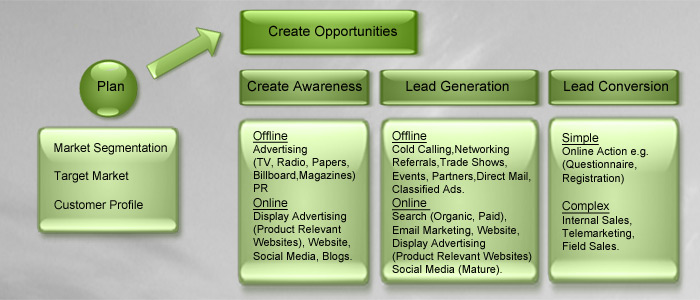
Digital (Online) Marketing integrated into the Sales Process
Digital Marketing allows niche markets to be targeted at a comparatively reduced cost.
Create Awareness
Use
- Display Advertising
- on websites that are relevant to the product being sold.
- Social Media & Blogs
- to engage with target market, to help educate and to announce new products.
- Email Marketing
- to distribute newsletters, whitepapers to stimulate interest.
- Website
- to educate.
Use in combination with Offline Marketing in the right blend to enhance success.
Generate Leads
Use
- Search (a mixture of organic and paid),
- Display Advertising (on websites that are relevant to the product being sold) &
- Email Marketing.
- Social media (networking and leads from engaged audience)
- Website (Capture inbound inquiries)
Use in combination with Offline Marketing in the right blend to enhance success.
Search has historically been the strongest digital channel for lead generation. It has been found that the yield is improved when combined with other channels such as Display Advertising.
Demonstrate Value using a Marketing Funnel
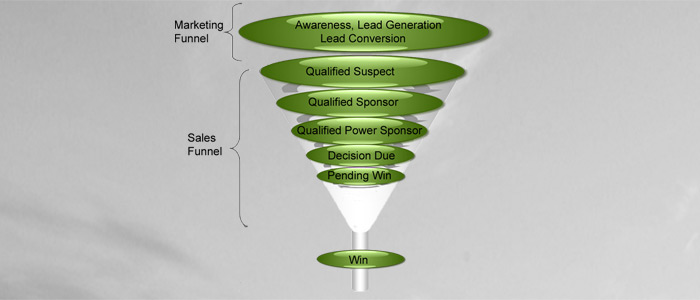
Use Marketing Funnel Above Sales Funnel to demonstrate Value
Whether you are B 2 B, B 2 C or non profit your marketing activities can be best viewed using the sales funnel.
Marketing at its heart is geared towards lead generation, but can also help in development and closure. The Value of any Marketing Campaign must be measured in the number of leads generated and opportunities created.
A Marketing Funnel may therefore be added above the Sales funnel. The exact breakdown of the Marketing and Sales Funnels will vary depending on the nature of the customer buying process. In general for B2B, the Marketing Funnel moves the target market members to Awareness, To Lead and To Converted Lead which then becomes an Opportunity for development by Sales. In Small Sales Teams, with no specialized Marketing help, this may well be all done by the sales team.
Demonstrate Value using an ROI Model
The actions to create a model are as follows:
- Map out a number of channels whereby a target company engages and becomes a lead, for example:
- Search Engine –>Main Site –>Download Whitepaper –>Registration
- Search Engine –>Blog–>Main Site–>Enquiry Form
- Twitter–>Blog–>Enquiry Form
- Facebook Fan page–>Main Site–>Enquiry Form
- Display Advertising Banner–>Product Microsite–>Main Site –>Enquiry Form
- Create KPIs and predicted relationships between KPIs and Leads generated, for example:
- Main Site Visitors
- Actions Performed (eg Download Whitepapers)
- Facebook Fans
- Twitter Followers
- Create Model
- Predict Customer sales
- Estimate Break down by Lead Generated and Path
- Estimate Costs
- Do Pilot Campaigns
- Compare Different blends and strategies
- Implement most successful on full market.
Initially, Social Media will be all about building awareness but if an engaged audience can be created then inevitably it will generate leads.
Social Media sites like Linked In are used by Sales Teams as part of their networking strategies.
Measurement and evaluation are very important. Every business is different and requires some testing to achieve the optimum blend of digital marketing channels.
Deliver Audience Engagement
The collateral benefit of Digital Marketing strategy is the creation and growth of engaged audiences (customers and prospects). A more engaged audience delivers the following benefits
- More Likely to purchase – A Mature engaged Social Media Audience can be a Lead Generation source.
- Better Retention – more likely to stay
- Brand Advocate leading to referrals and good references
Digital Marketing is Now Mainstream
Value Delivered is Nothing New.

The value delivered by Digital (or Online) Marketing is nothing new. It delivers, or helps to deliver:
- Insight into customer requirements
- Customer Sales
- Customer Service
Digital Marketing uses the internet which has taken market share from Newspapers and other traditional media and provides new ways of gaining customer insight and delivering customer service.
But, Digital Marketing Is Now Mainstream
But, Digital Marketing is now Mainstream and must be a key part of any sales and marketing strategy.
In the US it is a substantial $26Bn business (2010 comScore):-
- 15% year on year growth from 2009 (and 11% growth from 2008 – 2009 declined)
- 16% of the total advertising spend in the USA in 2011 (comScore and IAB/Pwc)
- 25% of predicted total advertising spend by 2015 (IAB/Pwc).
- No.2 in spend to TV. Newspapers number 3.
Globally, it is an estimated $55Bn business (using Google splits of US/International as guide)
The UK it is £4.1 Bn and is about 25% of the total Advertising spend( Enders Analysis).
- 13% year on year growth
- 25% of total advertising spend
Search still dominates . Search is dominated by Google at approx 70% market share with Microsoft Bing at approx 24% (comScore) now that it has done deals with Facebook and Yahoo.
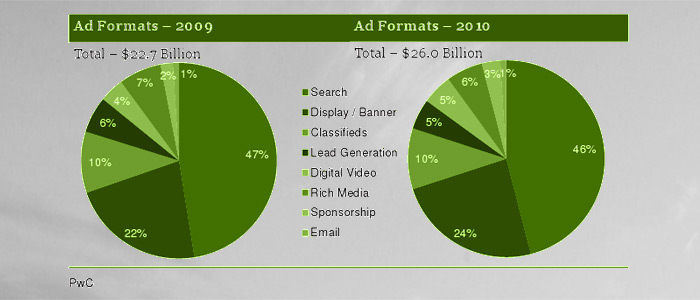
Display has shown good growth, driven by Social Media and led by Facebook. Facebook had approx 40% of all impressions in 2010 and passed the trillion mark with Yahoo next at half that amoun
Driven by the pull of Online Content
The growth in online content is pulling a greater audience online and keeping them there longer:-
- Stores (From Cars to Music)
- Entertainment (YouTube, BBC iPlayer etc)
- News (Mainstream to Blogs, Video to Text)
- Search
- Social Networks
The growth in richness of the online content is enabled by the growth in bandwidth to the home (in UK average is 6Mb and growing )and the penetration of internet globally.
And Online Advertising Cost Effectiveness
And the growth in the sophistication and cost effectiveness of online advertising:-
- Better targeting ( Using profiles on social networks and relevance by search or by product)
- Performance based pricing (Pay on Click through – accounts for 65% of all search advertising)
Use Value to drive Marketing Investment
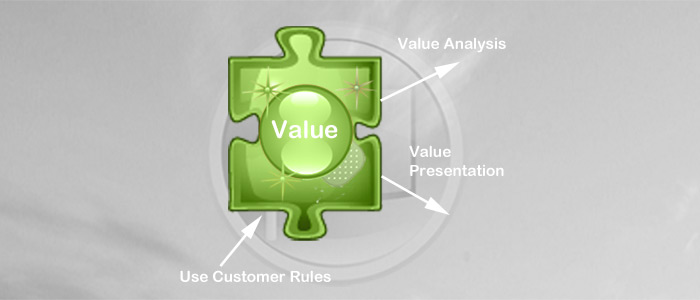
Use Value to drive Marketing investment
Value = Total Benefits-Total Investment.
The description of Value delivered by the marketing department will be much more powerful if linked to Value delivered to CEO and company objectives.
For instance the CEO may have a company objective
” increasing the Average Revenue Per User (ARPU) from £22 per month to £26 per month”
So a Value chain may be created that shows the Value that each department adds to the creation of this overall Value.
1. The Technical & Buying Departments must deliver a new data product for a specific investment
2. The Sales Department must generate a specific number of new sales by converting a certain percentage of qualified leads.
3. The Marketing Department must generate a specific number of qualified leads.
If you are selling equipment for a data product or a means of generating qualified leads then a conversation with the CEO based on the Value delivered in achieving his objectives will be better received and understood.
Equally, the marketing department will secure its budget easier if qualified in terms of delivering Value towards the company objectives.
Lead with Value, Close with Value
Best Relationships are based on Value
Best practice dictates the sale is opened, driven and closed with Value. Value must be described in terms that are relevant to the customer. The Value proposition normally includes (i) the delivery of a tangible customer goal, or the resolution of a customer issue or pain in clear quantifiable terms (ii) for an acceptable investment. Or in other words: Value = Total Benefits – Total Investment.
An example:-
” We believe that Company A should be able to
- Increase Average Revenue Per User from £22 per month to £26 per month resulting in an increase in profits of £5M per annum within the first year.
Through the ability
- To offer new data services
As a result of
- A network expansion and the creation and launch of a new data service
For an investment of
- £3M.
Based on the following Assumptions
- 3 new Network Nodes costing £2M.
- Network Management System £500K.
- Marketing Plan costing £500K.”
Value is referenced throughout the sale. It may well start with a straw-man, built using data from a previously successful customer or reference and extrapolated to address this particular customer. It will be developed as the sale proceeds as more detail on the solution is developed and information on the assumptions is discovered. In some cases, some pilots may need to be implemented to test some key assumptions in the value equation.
The best relationships in business have the delivery of value as their foundation. A sales person that is perceived to consistently deliver value (advice, information, solutions) will be better placed to form better relationships.
A Goal/Objective for the CEO flows down to the CMO and down to the marketing department.
For instance the CEO may have an objective of increasing the average revenue per user. This will be come a lead generation objective by the marketing department and an opportunity conversion objective by sales. A Value chain may be created to move from clearly known objectives at the top of the organisation to create new ones lower down the organisation.
Creating a High Performance Sales Team: – Hiring

The foundation for creating a high Performance Sales team is hiring the right Sales People
A key to success is to create a professional hiring process. This means that the role well defined and the process very professional. It will recognise, target and attract sales people with the potential to be high performers. Good people always have options so they must be sold to. Potential high performers are attracted by the the right company culture and its reward system.
The reward system includes monetary items but also many soft items such as job satisfaction growth prospects and status.