Posts Tagged ‘Sales Methodology’
The Poetry of Business Growth
I deliver Business Growth, by leading a great team
I show them how team success, helps achieve their dreams
The chance to make a difference and to do something good
The chance to build their skills and grow as as they should
The chance to provide, a future for their family
And build this future on merit, success and security
With all the barriers removed and no reason to hide
They will rise to success on the platform I provide
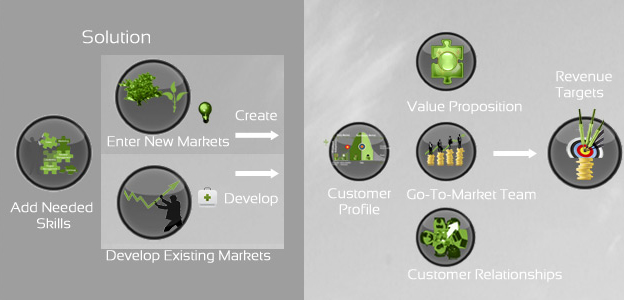
I start with Customer Profile and a Value Proposition,
Then the team to deliver, Customer and Revenue ambitions
Efficient and effective with tools, training and skills addition
We Begin and Establish Growth and later Optimise our position
From Market Entry to Development, it’s the same approach I feel
Better to use experience and process, and not reinvent the wheel
Diagnose the Challenge first, and then onto Solution creation
And then a project plan, for controlled Implementation
Creating High Performance Sales People
What makes a high performance sales team? What makes a high performance sales person? Can we analyse best practice and use it to improve ordinary sales people? Are relationships important? How important is Value?
To create a high performance sales team it is useful to analyse high performance sales people to understand what makes them successful. Such best practice can then be applied to a scalable sales model that will turn ordinary performers into stars.
Based on research by Sales Performance International and recently Dixon & Adamson in the Harvard Business Review the following was found:
High Performance Salespeople Get the Basics Right
- They work hard & work smart. They put in the hours, prepare well, use tools and training to ensure their efficiency and effectiveness
- They react and solve customer problems . They understand the value of a happy customer as future references and as a source of future business. They have the ability to manage the organisation to deliver the resources to solve the customer problems.
- They build solid relationships. They are honest and deliver on promises and build trust with their customers.
High Performance Salespeople Deliver Value
- Open with Value and Close With Value. Successful salespeople use their deep understanding of their customers’ business to challenge current thinking and to create new solutions to old problems. They have a very clear view of how they can deliver value to the the customer and use this to open and take control of sales conversations. They understand the different concerns of the key players in the buying team. They know that such concerns change throughout the sales cycle and they work had to ensure that such concerns are adequately addressed. Successful salespeople use value as the cornerstone in all phases of the sales cycle and especially during negotiation and close. They understand that it is important to present value in language and models that the customer is comfortable with.
Best Practice Used to Raise Performance of all Salespeople
The most successful high performance sales teams use best practice. They learn from high performing salespeople and use this best practice to create a sales model that is used to turn ordinary sales people into stars.
- Hire Salespeople with High Potential. Sales people with the basics of a good work ethic, good basic relationhip building skills and a desire to win.
- Use Leadership. Building a high performance team in any discipline requires leadership to ensure that the team is focussed and inspired to deliver.
- Use a Scalable Sales Model. This will take all the best practice of the high performance sales people and use it in training and coaching and tools to turn salespeople with high potential into stars. This will include a Sales Process, a Sales Management System, Sales Automation and Marketing Integration. All will combine to improve sales efficiency and effectiveness.
Fail to Plan, Plan to Fail

Plans - Improve effectiveness and efficiency. Don't waste time.
Plans improve Effectiveness and Efficiency
Effort spent in planning will reap rewards in sales effectiveness and efficiency.
Planning tools include Territory Plans , Account Plans & Opportunity Plans. These plans are most effective if stored on a Sales Automation system to ensure that the information is retained and communicated as required.
Territory Plan
A Territory Plan focuses on the segmentation of accounts and opportunities in a defined territory in order to prioritize which ones in which to invest sales resources. It will normally include:
- Customer Profile and Qualification Criteria
- Market Analysis
- Segment Accounts by Business Potential and Current Business Relationship
- Alpha High Future Business Potential – prioritised by level of current relationship
- Beta – Moderate to Low Business Potential, high level of Current Relationship
- Delta – Little or no near term Business Potential, insufficient data to accurately assess potential, low level of current relationship
- Territory coverage strategy
- Messaging Strategy
- Resources allocated to Alpha, Beta and Delta accounts.
Account Plan
- Account Profile
- Company, Financials, Offerings, Market Analysis, Competition, Exec Biogs, Likely Business Issues, Potential Capabilities Required
- Install Base
- Recurring Revenues
- Customer Satisfaction levels
- Recent Projects
- Key Player List Summary
- Account Team & Coverage Summary
- Current Initiatives/Projects happening inside the Account
- White Space & Share of Wallet analysis
- Current & Future Opportunities
- Total Opportunity Portfolio
- Action Plan
- Resource Plan
Opportunity Plan
Each Opportunity will have its own plan. The size of the plan will be in relation to the size of the opportunity. It will normally include:
- Business Pain/Issue
- Value Proposition
- Customer Rules
- Analysis & Presentation
- Is it compelling?
- Key Player List
- Coverage strategy
- Access to key personnel?
- Qualification Status
- Solution Creation status
- Evaluation Plan /Buying Process
- Competitive Strategy
- Analysis of Strength and Position
- Negotiation & Close Strategy
- Implementation Plan
Lead Generation Terminology
Target Market
The Target Market or Target Market segment is a list of companies (B2B) or consumers (B2C) that possess the required buyer profile that make them pre-disposed to buy the product.
Territory
A territory is a part of the target market which has been allocated to a sales person or sales team.
A Lead
A lead is a potential opportunity sometimes known as a prospect – For example, a person met at a conference who expressed interest, or someone who filled out a form on the company website.
Lead Conversion (Or Qualification)
If the lead is qualified and the salesperson and decides to pursue it, the lead is “converted,” and becomes an opportunity. ( Note that the term conversion is used somewhat loosely and in many cases in Digital Marketing does not end up with an opportunity but with a (more qualified) lead that still requires further qualification before it becomes an opportunity.
An Opportunity
Opportunities are the sales and pending deals that are tracked in that Sales Pipeline or Funnel. The pipeline is built by adding more opportunities will contribute to the forecast.
Opportunity Qualification
Opportunity Qualification means that the prospect has provided information and performed certain actions that show that they are at a minimum in the market for the product, have the budget to buy and are willing to do so within a reasonable timeframe.
Qualification is tailored to the specific sales process which is itself aligned to the specific buying process in place.
In a simple B2C eCommerce transaction the qualification is a very simple process.
In B2B solution selling the qualification is a process that may be spread over weeks or months that forms a large part of the sales process due to the relative complexity of the buying process.
For instance in B2B solution selling:
- A Lead may be qualified initially by an internal telemarketing team who may deem it good enough to pass on to the field sales team.
- The Field sales team would initially qualify the company known as a suspect to avoid confusion with the term prospect. At this stage it would enter the funnel as a qualified suspect.
- Further levels of Qualification would then take place with the other members of the buying team such as the Sponsor (Person Driving the Project) and the Power Sponsor (Normally at Executive or C Level).
An Account
An account is the company or consumer that makes the purchase. An account may deal with several opportunities.
Lead with Value, Close with Value
Best Relationships are based on Value
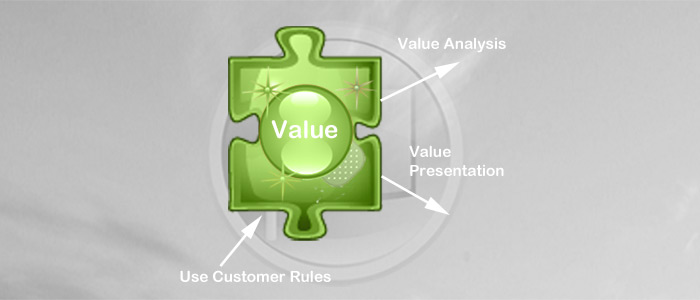
Best practice dictates the sale is opened, driven and closed with Value. Value must be described in terms that are relevant to the customer. The Value proposition normally includes (i) the delivery of a tangible customer goal, or the resolution of a customer issue or pain in clear quantifiable terms (ii) for an acceptable investment. Or in other words: Value = Total Benefits – Total Investment.
An example:-
” We believe that Company A should be able to
- Increase Average Revenue Per User from £22 per month to £26 per month resulting in an increase in profits of £5M per annum within the first year.
Through the ability
- To offer new data services
As a result of
- A network expansion and the creation and launch of a new data service
For an investment of
- £3M.
Based on the following Assumptions
- 3 new Network Nodes costing £2M.
- Network Management System £500K.
- Marketing Plan costing £500K.”
Value is referenced throughout the sale. It may well start with a straw-man, built using data from a previously successful customer or reference and extrapolated to address this particular customer. It will be developed as the sale proceeds as more detail on the solution is developed and information on the assumptions is discovered. In some cases, some pilots may need to be implemented to test some key assumptions in the value equation.
The best relationships in business have the delivery of value as their foundation. A sales person that is perceived to consistently deliver value (advice, information, solutions) will be better placed to form better relationships.
A Goal/Objective for the CEO flows down to the CMO and down to the marketing department.
For instance the CEO may have an objective of increasing the average revenue per user. This will be come a lead generation objective by the marketing department and an opportunity conversion objective by sales. A Value chain may be created to move from clearly known objectives at the top of the organisation to create new ones lower down the organisation.
Creating a High Performance Sales Team: – Sales Model
Use Sales Model with Leadership to create high performance culture
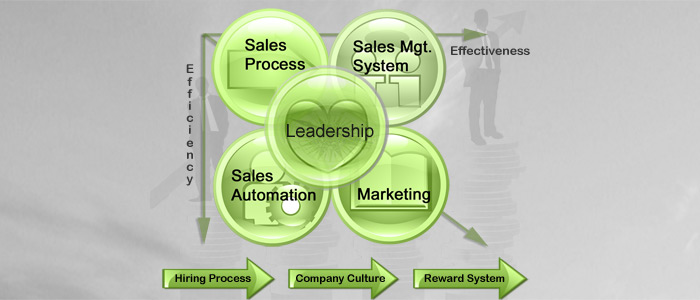
A High Performance Sales team is created by combining good hiring of sales people with Leadership with a scalable sales model.
The sales model will improve efficiency and effectiveness by implementing:-
- A Sales Process (Increases efficiency and effectiveness)
- A Sales Management System (Increases effectiveness with some efficiency)
- A Sales Automation System (Increases efficiency with some effectiveness)
- Integrate Marketing (Increases efficiency and effectiveness)
High performing sales people (stars) have a unique combination of skills and knowledge. They excel at building customer relationships, developing successful strategies, managing internal resources and beating their targets every year. A sales model will take the best of these skills and experience and turn an average sales person into stars.
Read more at Sales Model.