Archive for the ‘High Performance Sales Team’ Category
Leadership is about Clearing the Obstacles

Once, as a team, you have decided that you are running in certain direction, then it’s the leader’s job to clear the path, get the obstacles out of the way and make it fast to make decisions.
Another way of saying this is that it’s the leader’s job to create the environment for success and the largest part of this is about clearing barriers to performance out of the way. Find and remove the objections to achieving the objectives.
The Poetry of Business Growth
I deliver Business Growth, by leading a great team
I show them how team success, helps achieve their dreams
The chance to make a difference and to do something good
The chance to build their skills and grow as as they should
The chance to provide, a future for their family
And build this future on merit, success and security
With all the barriers removed and no reason to hide
They will rise to success on the platform I provide
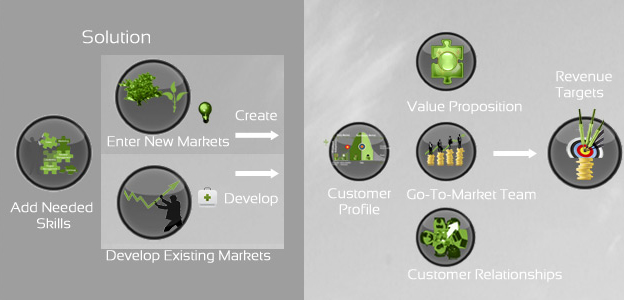
I start with Customer Profile and a Value Proposition,
Then the team to deliver, Customer and Revenue ambitions
Efficient and effective with tools, training and skills addition
We Begin and Establish Growth and later Optimise our position
From Market Entry to Development, it’s the same approach I feel
Better to use experience and process, and not reinvent the wheel
Diagnose the Challenge first, and then onto Solution creation
And then a project plan, for controlled Implementation
Product Management vs Product Marketing Activities
Titles really are a mess. What one company calls a product manager, another calls a product marketing manager. It is best to be aware of this and to focus on the activities required. Also where these people do not exist in an organisation other departments fill the void. So the activities may be performed (poorly) by technical, sales, operations or marketing communications.
Typically the title “product manager” is used to signify people who listen to the market and articulate the market problems in the form of requirements. And the title “product marketing manager” is usually assigned to those who take the resulting product to the market by defining a product marketing strategy.
In Crossing the Chasm, Geoff Moore defines (and recommends) two separate positions:
A Product Manager (PM) listens to the market
 “A product manager is a member of either the marketing organization or the development organization who is responsible for ensuring that a product gets created, tested, and shipped on schedule and meets specifications. It is a highly internally focused job, bridging the marketing and development organizations, and requiring a high degree of technical competence and project management experience.”
A Product Marketing Manager (PMM) talks to the market
 “A product marketing manager is always a member of the marketing organization, never of the development group, and is responsible for bringing the product to the marketplace and to the distribution organization… it is a highly externally focused job.”
In reality, there is a blurring of activities and the captions used (talking and listening) are used for simplicity, clarity and guidance rather than laws. The activities performed by the roles are as follows:
Product Management Activities
- Define Market Opportunity,
- Define User Personas for individual products.
- Create Product Requirements & Use Scenarios,
- Analyse Competitive Landscape,
- Define Product Differentiation & Position Product,
- Create Business Case, Acquire Funding,
- Create Product Roadmap, Develop Product,
- Launch Product, Manage Product Lifecycle.
Product Marketing Management Activities
- Articulate Product Objectives,
- Articulate Product detail ( differentiation, positioning, applications, pricing and USP), Understand Market (needs, problems,& segmentation, priority, size, customer profiles and purchase processes),
- Understand Competition,
- Build Go to Market plan ( value proposition, sales process, select/create sales channels and objectives, message map, demand generation strategy, promotion strategy, sales guide, sales support & collateral, sales training, pipeline management, metrics, systems, budget, schedule),
- Execute Plan ( launch event, launch team).
- Conduct Win/Loss analysis.
Director, Product Strategy Activities
In organisations where a Director, Product Strategy exists then they may take on more of the strategic and less tactical activities.
- Discover and validate market problems (both existing and future customers)
- Seek new market opportunities by leveraging the company’s distinctive competence
- Define and size market segments
- Conduct win/loss analysis
- Determine the optimum distribution strategy
- Provide oversight of strategy, technical, and marketing aspects of all products in the portfolio
- Analyze product profitability and sales success
- Create and maintain the business plan including pricing
- Determine buy/build/partner decisions
- Position the product for all markets and all buyer types
- Document the typical buying process
- Approve final marketing and go-to-market plans
Sales Problems may point to poor Product Management & Product Marketing
Sales problems are very visible.
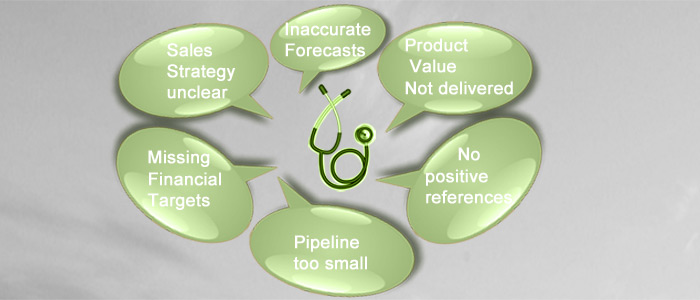
Targets are not met. Customers are not acquired. Pipelines are not healthy. Forecasts are not met.
Often the immediate reaction is to blame the sales personnel. Typical questions are: Are they working hard enough. Are they working smart enough? Do they have the right relationships. Are they looking in the wrong places. Do they understand customer problems? Do they understand the product value? Can they present the value of the product effectively?
Diagnose, Create & Deliver
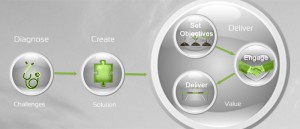
While sales personnel can always up their game, in many cases the root problems can be elsewhere. If Product Management and Product Marketing processes been ignored, or not done correctly then the following problems may be diagnosed
Diagnosis
- Do product differentiators exist and are they understood?
- Is product positioning clear and understood?
- Have the correct target market segments been identified?
- Is the product fully developed and bug free?
- Does the product provide the whole solution for the customer or are partner products required?
- Is the product perceived as too expensive?
- Is the value of the product understood and presented well enough?
- Are the value messages available for all of the key players in the customer organisation?
- Do suitable message vehicles exist? Do sales tools exist?
- Are there reference customers available that are acceptable to target customers?
Create & Deliver Solution
A solution must then be created and delivered. Depending on the organisation this may be done by Product Management and Product Marketing.
Product management is inward focussed and product marketing is outward focussed.
- Utilise Differentiators – Articulate product differentiators, and combine with customer profiling and competitive analysis to position products correctly and to drive messaging.
- Prioritise Target Customers – Utilise market analysis and product positioning to prioritise demand generation and sales activities
- Finalise Development – Create project plan and obtain high level management sponsorship to finalise development.
- Create Whole Solution – The construction of the solution may be done directly or via a third party such as an integrator. In Early markets the customer will normally provide this function either directly or via a third party.
- Execute Pricing Review – Ensure that value is demonstrated clearly by better presentation or if required a pricing reduction or re-organization.
- Create Better Value Presentation – Include all the value elements and simplify presentation in line with the customer financial modelling. Include as a standard sales tool.
- Acquire Reference Customers – Provide sufficient support to sales personnel to target and acquire reference customers.
Project management methodologies and tools can be used as appropriate to deliver solutions efficiently and effectively.
Management is not Leadership

Leadership & Management are confused much of the time. What is the difference? The following has been extracted from an article in HBR by John Kotter. He expresses it well in my view.
It is important to stress that it is wrong to romanticize one to the detriment of the other. Both are very important. In a world of rapid change and ever more complex organisations we need both to be at the top of their game…but they are different and confusion does not help.
The Mistakes people make…
The mistakes people make on the issue are threefold:
Mistake #1: People use the terms “management” and “leadership” interchangeably. This shows that they don’t see the crucial difference between the two and the vital functions that each role plays.
Mistake #2: People use the term “leadership” to refer to the people at the very top of hierarchies. They then call the people in the layers below them in the organization “management.” And then all the rest are workers, specialists, and individual contributors. This is also a mistake and very misleading.
Mistake #3: People often think of “leadership” in terms of personality characteristics, usually as something they call charisma. Since few people have great charisma, this leads logically to the conclusion that few people can provide leadership, which gets us into increasing trouble.
Management is “Doing things right”…
Management is a set of well-known processes, like planning, budgeting, structuring jobs, staffing jobs, measuring performance and problem-solving, which help an organization to predictably do what it knows how to do well. Management helps you to produce products and services as you have promised, of consistent quality, on budget, day after day, week after week. In organizations of any size and complexity, this is an enormously difficult task. We constantly underestimate how complex this task really is, especially if we are not in senior management jobs. So, management is crucial — but it’s not leadership.
Leadership is “Doing the right things”…
Leadership is entirely different. It is associated with taking an organization into the future, finding opportunities that are coming at it faster and faster and successfully exploiting those opportunities. Leadership is about vision, about people buying in, about empowerment and, most of all, about producing useful change. Leadership is not about attributes, it’s about behavior. And in an ever-faster-moving world, leadership is increasingly needed from more and more people, no matter where they are in a hierarchy. The notion that a few extraordinary people at the top can provide all the leadership needed today is ridiculous, and it’s a recipe for failure.
Customer Service: The John Lewis Way

I recently had the pleasure of working inside John Lewis and experiencing first hand how they deliver customer service that’s admired. I enjoyed working with the company. The customers and staff (partners) are in general happy, very polite and helpful and the company has a great atmosphere which is a credit to them. This has not happened overnight. The trust that customers have in John Lewis takes a long time to build but much easier to lose. How have they created this? First are the founding principles of Customer Service in John Lewis –
“Be honest; give respect; recognise others; show enterprise; work together; achieve more.”
Then my impressions…
1. “We’re Based on the Notion that if we Treat our Partners well, it will lead to Good Customer Service.”
This is a simple idea but one few companies really put into practice. John Lewis implement it in a number of ways:
- Partnership
- Staff are called and treated as partners
- All partners are owners in the business and get a yearly bonus based on performance
- Managers served staff at Xmas lunch
- Partnership concept breaks down barriers and creates meritocracy
- Respect
- Respect for each other and for customers is a core value within John Lewis
- Managers and staff were generally very helpful to one another and to customers
- No difference between how customers and partners were treated…indeed partners were often customers
- Trust
- Trust partners and empower them to do well
- In general partners were given space to to their jobs and to succeed and
- Soft Benefits to create family effect
- Subsidised canteen, discount card, subsidised, sports , subsidised concerts, holiday homes etc…
- Social club with great parties etc.
2. Empower Staff
- Train staff well
- Empower them to make do the right thing. This may be asking a manager or acting on the customer’s best interests depending on the situation. They are encouraged to think outside the box once the basics have been understood and acted upon. Staff are expected to show enterprise in the right context
- Staff are product experts in their areas and have built up this expertise over time and through training.
- Be honest – if you don’t know do not waste the customer’s time. Find somebody with the right answer. Bring the customer to the answer if required.
3. Get and Act on Customer Feedback
- Headquarter staff spend a few days serving over peak periods. This helps to give better customer service overall but also gives them immediate insight into the problem areas that customers are facing.
- Staff are expected to communicate issues regularly and many forums are created whereby this is done in a formal way
4. Make Online and Store seamless
- Returns for online can be done in store at any till with systems work behind the scenes to improve this process ongoing. This can be much better than having to repackage it and post it back to other online retailers.,
- Maintain exceptional customer service online. Customers have access to people when they need it and can use Waitrose and John Lewis stores to pick up their purchase rather than missing the delivery at home.
- Online is becoming a huge part of the overall service offered by John Lewis allowing customers to purchase when stores are closed. The John Lewis Clearance sales started on Xmas eve.
5. Make Customers Life Easy
- Shopping can be stressful and unpleasant in the wrong environment. John Lewis try to help make it a pleasant environment.
- Create a calm environment that is pleasant to look at and products are easy to find. Do not overburden with selling messages in flash colours
- Keep queues to a minimum by hiring temporary staff for peak times to help at till as and free up existing staff to answer questions and give advice. Also deploy HQ staff to help out.
- Provide a customer collection point that will collect all customer purchases in one location to ensure that they are not overburdened with bags
- Provide home delivery options from store
- Provide delivery options to John Lewis or Waitrose stores
- Provide extensive gift list and gift wrapping services
- Staff are honest and if they cannot answer will say so but will find someone who can and will not leave the customer until they are assured that the customer is being served by someone able inside John Lewis.
6. Be Different
- Never knowingly undersold
- John Lewis will match competitor prices if evidence is presented that is relevant and reasonable.
- Staff are empowered to do this on the fly with manager’s approval.
- Systems will support on the fly one off discounting.
- Have an exceptional returns policy
- John Lewis customers are trusted implicitly and when they bring back a product that they are not happy with it is changed often without question. This could be abused but at a macro level this creates tremendous good will and indeed more purchases. Often customers need to see the product in the home environment before being really sure and if they could postpone or not purchase if the returns policy was too difficult.
- Have an exceptional warranty on electricals
- John Lewis provides market leading warranties on electrical items whilst maintaining competitive prices.. This has become more important a sthe options on the high street narrow.
7. Hire people who share the John Lewis vision
- Hire people who will take on the values of John Lewis and take it forward. The gatekeepers that hire staff into John Lewis have an important job to hire people that will not abuise the trust and respect gievn to them by partners and customers.
You’ve Gotta Laugh! – Humour in the Workplace

We laugh so often that we never stop to ask what is it for. In fact ask the question and the recipient will be waiting for the punchline (thinking it is a joke!). But in a business context what is humour for? Why do we have some of our best times when we enjoy a good laugh in a group? Are there negative aspects to humour? Why do we sometimes feel angry or hurt when in a group that are laughing at a joke – maybe at our expense?
Well, like many of the social tools we use, humour is such a part of our human interactions that we use it and react to it unconsciously. But where did it come from and where did it start?
Some scientists reckon that humour was originated to help with procreation.
Scientists have proposed a variety of evolutionary theories of humour that mostly boil down to getting an edge in the chase for a mate. American evolutionary biologist Richard D Alexander, for example, suggested in his 1986 book Ostracism and Indirect Reciprocity: the Reproductive Significance of Humour, that the point of telling jokes was to raise one’s own status, lower that of certain other individuals, and enhance social unity…..And to get laid.
In the work environment, status is important and humour is used with varying degrees of success to raise that of the joker and reduce that of the target. If you are the target of an experienced joker, you may be seething inside but will have to laugh along as you find it impossible to find enough ground to take issue. How many times have you thought up a witty riposte hours later and wished you could have used it.
Humour is sometimes used to make serious points and to communicate messages that the originator cannot or is afraid to communicate seriously. This a poor use of humour as again it may be divisive.
Humour for social unity is one that we all enjoy because it is inclusive and non divisive whereas status driven humour may be exclusive and divisive. Status humour about groups can include social unity as a by product but it applies to specific groups inhabited by the joker.
So use humour in the workplace to promote social unity, to release tension and create a friendly and enjoyable workplace.
Beware of humour that promotes individual status or agendas.
Leadership Insights
Leadership Questions

Leadership has historically caused much debate and raised many questions:
- Are leaders born or made?
- What makes a leader?
- Do different environments require different leaders.?
- Is a leader, a leader all of the time?
The good news is that we all can be leaders. It requires the right circumstances. It requires practice.
We will not be leaders all of the time but we need only be leaders for enough time to get the job done.
The following will explore these questions in more detail.
What is leadership?
Aristotle defined leadership as requiring Knowledge,Skills and Practical Wisdom – the ability to see the good and realize it in a specific situation. All three are necessary and mutually supportive.
In The Art of War, Sun Tzu characterized leadership as a mix of five traits: Intelligence, Credibility, Humaneness, Courage, and Discipline.
Montgomery defined leadership as:
“The capacity and will to rally men and women to a common purpose and the character which inspires confidence”.
The Arbinger Institute talks about self deception & “being in the box”. Being “in the box” means being being boxed in by your fears, doubts, uncertainties and limiting beliefs such that you do not connect with others and do not focus on that you care about. Good leaders are honest with themselves and are ” in the box” much less of the time.
Peter Drucker states “Your first and foremost job as a leader is to manage your own energy, and help manage the energy of those around you”.
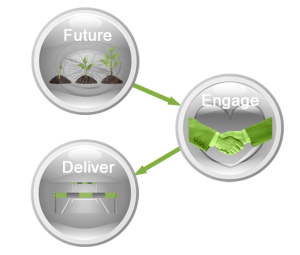
Steven Radcliffe talks about a leader:
- Creating a vision of a better future
- Engaging a team to commit their energy to deliver such a future
- Delivering results
As a leader, you must care for a better future
Leadership is not just about competencies, skills and personality. It’s first and foremost about being in touch with what you care about and then going for it. You won’t be a great leader for things you don’t care about!
By its nature a better future involves working in areas that are new and where you are instigating change to achieve this better future. Managers normally focus on delivery within defined parameters and deal with much less uncertainty.
A better future requires strategy and planning once the idea has been conceived. This will ensure that it is indeed a better future.
You must be at your best more of the time
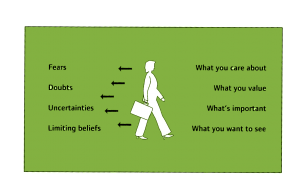
Peter Drucker states “Your first and foremost job as a leader is to manage your own energy…..and then help manage the energy of those around you”.
It does all start with you, how you manage yourself to be at your best more of the time.
If you are at your best, you are focussed on the future and not held back by the present. You are more engaging and this creates a powerful platform to help others to be at their best.
The Arbinger Institute talks about “being in the box”. Being in the box means not being being boxed in by your fears, doubts uncertainties and limiting beliefs such that you do not connect with others and do not focus on that you care about. Good leaders are in the box much less of the time.
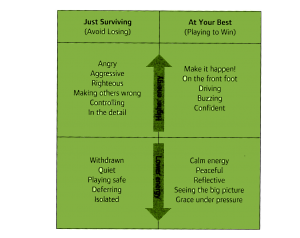
All of us have the capability to be leaders but we need to believe in ourselves as a leader and get into the right frame of mind. An effective leader is “Playing to Win” and is not just “Trying not to Lose”. As an effective leader you are “At Your Best” and not “Just Surviving” . An effective leader will exhibit high energy or low energy at different times for different tasks. These are not fixed states. We all are in all of these some of the time. We will not be leaders all of the time. But the best leaders manage to be in “Play to Win” and “At Your Best” states most of time.
You must help others be at their best more of the time
Leaders must make big requests so they must have relationships that are big enough to get the job done.
They must help people be at their best. They must help them overcome their limitations – their fears, doubts, uncertainties and limiting beliefs and to focus on what they care about.
Leaders must look for and remove obstacles in the environment that are hindering team progress.
You must engage others to care about your vision of the future.
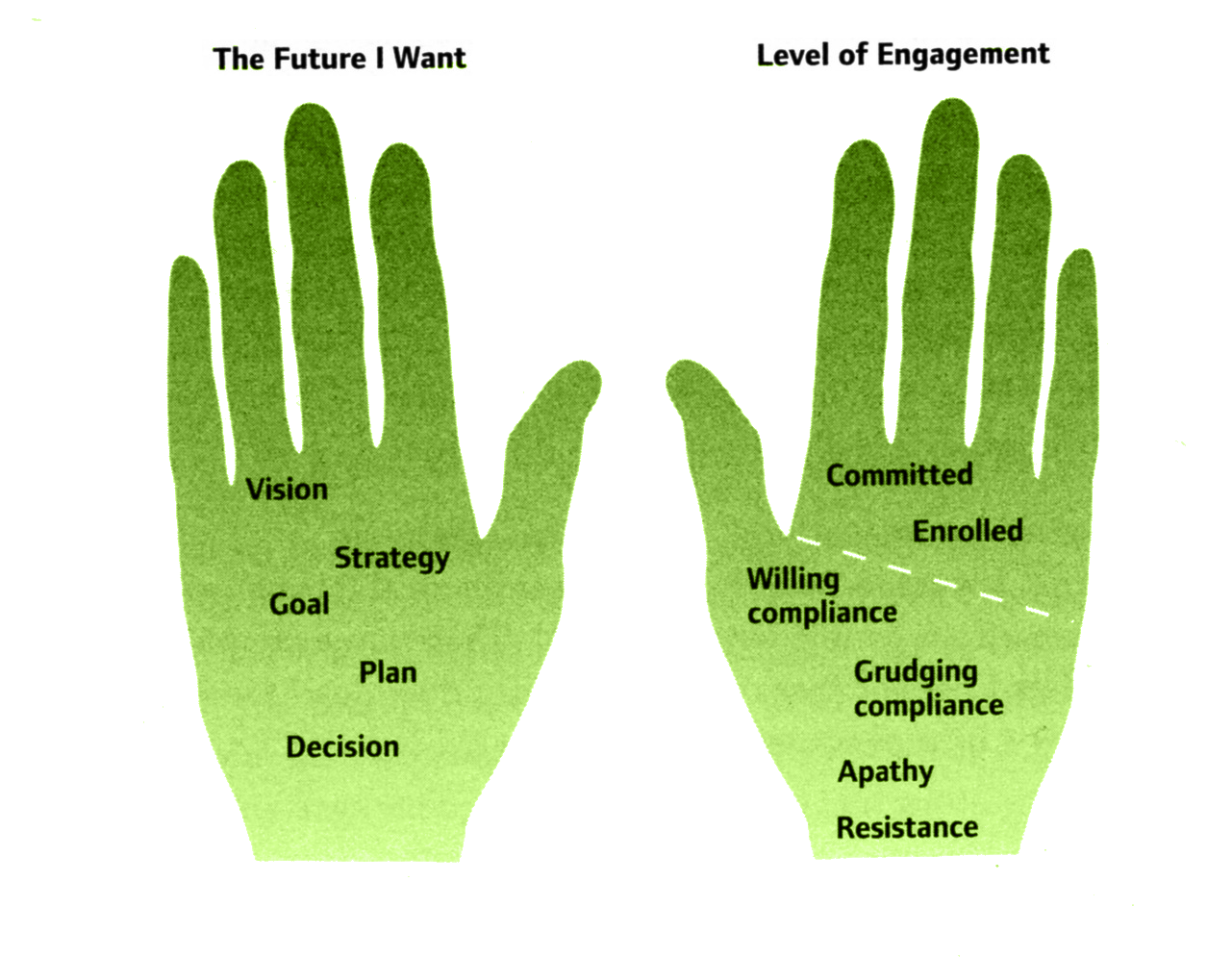
Engage people so they want to work with you and build a future with you.
Crucially engagement is absolutely distinct from ‘communicating to’, ‘presenting at’ or telling.
It is about how you connect with people, how you stimulate their thinking and impact their energy.
Engaging others is a two-way interaction and its something that happens inside your relationships. It is about your ability to build relationships big enough to get the job done.
Engagement is about taking people through resistance, apathy, grudging compliance, willing compliance, to enrolled and finally to committed.
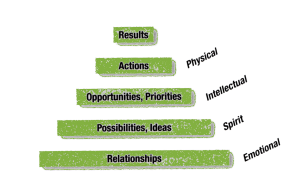
Engagement is:
- supported by building Relationships big enough to get the job done
- fuelled by Possibilities that others can see for themselves linked to the Future they want
- sharpened by agreement on specific Opportunities and Priorities
- creating a bridge to Deliver by making Big Requests of others to elicit Promises to take Action.
You must deliver results
Delivery is not standalone
Delivery is where we are all judged, is the most visible part of leadership but is not standalone. Without a compelling Future and without engaging in that future delivery of the right results will not happen.
Delivery requires you to mean it
To get great delivery you have to mean it when you make big requests. Meaning it means that your team is in no doubt of your expectations from what you say and from what you do.
For instance…making too many requests may well mean that none are done well. Not following up may mean that your team becomes distracted. Remember the maxim ” people do what you inspect, not what you expect”. There are no avoiding some difficult converstations when performance falls below that required or expected.
In delivery a leader is expected to exhibit fierce resolve, emotional fortitude, focus, discipline and resilience to ensure that the team remains focussed, acts with high energy and delivers results.
Deliver today but grow people to deliver even more tomorrow
Get the best from yourself and others today but commit to growing yourself and others so that the capability to deliver increases into the future.
How do we become leaders?
We become leaders through 1. Conscious Practice, 2. Using a Personal Support Team 3. Knowing and Going beyond our limits and 4. Being in the right State of Mind.
Conscious Practice.
Conscious Practice. You do most of your learning in real-life situations and the more you practice the better you get. Consciously use situations and challenges as opportunities to learn and grow.
- Be guided by the future you want
- Embrace the big picture
- Engage rather than transmitting/communicating
- Build Big Relationships
- Manage your Shadow (Don’t be “in the box”, manage yourself such that your uncertainties or anxieties do not cast a shadow on your team. Be in a position to help your team be at their best)
- Make Big Requests
- Maximise Probability of Delivery
- Acknowledge acceptable Delivery
- Fix Delivery that has problems
- Wrap Up
Use a Personal Support Team
Use a personal Support Team for feedback. Identify the specific ways you want to grow as a leader, tell selected colleagues and ask them to rate you now. Then ask them if they’ll watch out for you in these areas to help you make progress.
Know and go beyond your limits.
- Get beyond the present
- Embrace the big picture
- Accept that you will not know how to achieve your Future
- Believe you are a leader
- Be in leader mode (rather than operator/manager mode)
- Overcome: I’m only….I’m not….I’m just…
Be in the right state of mind
Recognise your state of mind and work out how to ensure you are “At Your Best” and “Playing To Win”.
Recognise the triggers that push you into “Just Surviving” mode and ensure you manage or avoid them to spend more time “Playing to Win”.
Achieving Business Growth
Challenge
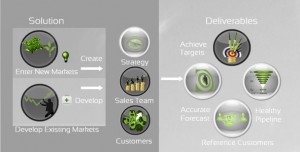
The overriding challenge in sales and marketing is “To deliver business growth”.
How to Address
Take the right approach.No one size fits all. So to be most efficient and effective it is best to:
- Diagnose Challenge,
- Create Solution & then
- Deliver Results.
The challenges will fall into two broad categories
- Enter new markets or
- Develop existing ones.
Diagnose Challenge
The main ingredients of success are:
- Strategy,
- Sales team (& infrastructure),
- Customer acquisition( tailored sales process, product value, & customer references)
Create Solution
Following the diagnosis of the challenges a bespoke solution may be created.
Create/Develop Strategy
Planning means that subsequent action will effective and efficient.
- Create customer profile,
- Value proposition,
- Go to Market strategy,
- Sales process,
- Sales team,
- Targets.
Create/Develop Sales Team
This includes Leadership, Scalable Sales Model and Hiring the best people.
Leadership means that the team energised, have clear objectives, are fully engaged and deliver the required targets wit the required cost. The team is supported by a scalable sales model which includes:
- Sales Process based on Customer Buying Process
- Sales Management System to to deliver forecasts and processes for coaching and performance management
- Sales Automation that improves the efficiency of communication, customer database and reporting.
- Marketing Integration for lead generation, sales tools, messaging and effective market coverage.
Hire the best people. Utilise a clear and professional process to identify and develop people with high potential.
Begin/Develop Customer Acquisition
Customer Acquisition is vital for revenue Growth and the creation of references to enable later customers to be acquired more efficiently. Both are key attributes of business growth.
First ensure product delivers compelling value. as perceived by the customers. Then create or develop references.
To win major breakthrough accounts will require the creation of a tailored sales process based on the customers buying process. This will help harness the resources of the company effectively, manage communication and monitor progress.
Deliver Results
Results will be best delivered by effective leadership and professional project management.Leadership ensures that clear objectives are set and resources to deliver such objectives are secured.Then the team to deliver the results is engaged such that they are fully committed to deliver superb results.Finally the results are delivered with progress monitored and reported on at regular intervals to keep stakeholders informed.
Creating Customer Solutions
Understand: the Customer’s Business Model
A business model is made up of the following elements:
- Customer Segments Served: Who are they creating value for? Who are their most important customers?
- Value Propositions: What value are they delivering to customers? What customer’s problems are they helping to solve? Which customer needs are they satisfying?
- Channels to Market: Through which Channels do their Customer Segments want to be reached? How are they reaching their Customer Segments now?
- Customer Relationships: What relationships do each of the customer segments expect? What ones have been established? How costly are they?
- Revenue Streams: What value are customers willing to pay and what are they currently paying?
- Key Resources: What key resources are required by Value Proposition, Channels, Customer Relationships & Revenue Streams?
- Key Activties: What key activities are required by Value Proposition, Channels, Customer Relationships & Revenue Streams?
- Key Partnerships: Who are their Key Partners & Key Suppliers. Which Key Resources are they acquiring from partners? Which Key Activities do partners perform?
- Cost Structure: What are the most important costs inherent in the business model? Which Key Resources are the most expensive? Which Key Activities are the most expensive
Diagnose: Pain Points
Diagnose where the customers pain points are in their business model:
- Find new customer segments?
- Create new value propositions?
- Reach customers more effectively?
- Increase Revenue Streams?
- Provide new key resources or key resources with better attributes?
- Increase key activities efficiency?
- Replace one of their key partners?
- Reduce cost structure ?
Create: Solution
Create a solution:-
- Define benefits
- Define investment
- Demonstrate capability using references and endorsements
- Communicate in customer’s language showing Return On Investment.
Communicate: Solution
Resolve concerns on solution, risk and price.
Communicate in customer’s language showing Return On Investment.
Deliver: Solution
Deliver the solution.
Use project management tools to manage delivery.
Demonstrate that benefits have been delivered. Ensure customer satisfaction.