Posts Tagged ‘Major Account Selling’
Fail to Plan, Plan to Fail

Plans - Improve effectiveness and efficiency. Don't waste time.
Plans improve Effectiveness and Efficiency
Effort spent in planning will reap rewards in sales effectiveness and efficiency.
Planning tools include Territory Plans , Account Plans & Opportunity Plans. These plans are most effective if stored on a Sales Automation system to ensure that the information is retained and communicated as required.
Territory Plan
A Territory Plan focuses on the segmentation of accounts and opportunities in a defined territory in order to prioritize which ones in which to invest sales resources. It will normally include:
- Customer Profile and Qualification Criteria
- Market Analysis
- Segment Accounts by Business Potential and Current Business Relationship
- Alpha High Future Business Potential – prioritised by level of current relationship
- Beta – Moderate to Low Business Potential, high level of Current Relationship
- Delta – Little or no near term Business Potential, insufficient data to accurately assess potential, low level of current relationship
- Territory coverage strategy
- Messaging Strategy
- Resources allocated to Alpha, Beta and Delta accounts.
Account Plan
- Account Profile
- Company, Financials, Offerings, Market Analysis, Competition, Exec Biogs, Likely Business Issues, Potential Capabilities Required
- Install Base
- Recurring Revenues
- Customer Satisfaction levels
- Recent Projects
- Key Player List Summary
- Account Team & Coverage Summary
- Current Initiatives/Projects happening inside the Account
- White Space & Share of Wallet analysis
- Current & Future Opportunities
- Total Opportunity Portfolio
- Action Plan
- Resource Plan
Opportunity Plan
Each Opportunity will have its own plan. The size of the plan will be in relation to the size of the opportunity. It will normally include:
- Business Pain/Issue
- Value Proposition
- Customer Rules
- Analysis & Presentation
- Is it compelling?
- Key Player List
- Coverage strategy
- Access to key personnel?
- Qualification Status
- Solution Creation status
- Evaluation Plan /Buying Process
- Competitive Strategy
- Analysis of Strength and Position
- Negotiation & Close Strategy
- Implementation Plan
Lead with Value, Close with Value
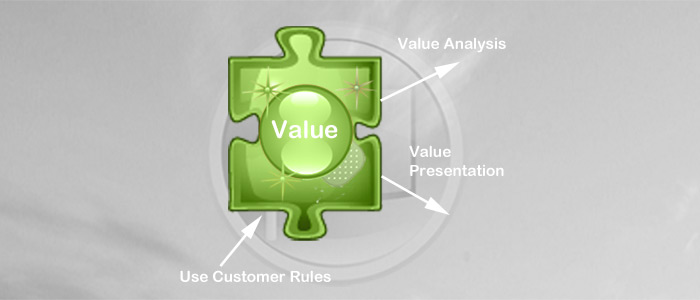
Best Relationships are based on Value
Best practice dictates the sale is opened, driven and closed with Value. Value must be described in terms that are relevant to the customer. The Value proposition normally includes (i) the delivery of a tangible customer goal, or the resolution of a customer issue or pain in clear quantifiable terms (ii) for an acceptable investment. Or in other words: Value = Total Benefits – Total Investment.
An example:-
” We believe that Company A should be able to
- Increase Average Revenue Per User from £22 per month to £26 per month resulting in an increase in profits of £5M per annum within the first year.
Through the ability
- To offer new data services
As a result of
- A network expansion and the creation and launch of a new data service
For an investment of
- £3M.
Based on the following Assumptions
- 3 new Network Nodes costing £2M.
- Network Management System £500K.
- Marketing Plan costing £500K.”
Value is referenced throughout the sale. It may well start with a straw-man, built using data from a previously successful customer or reference and extrapolated to address this particular customer. It will be developed as the sale proceeds as more detail on the solution is developed and information on the assumptions is discovered. In some cases, some pilots may need to be implemented to test some key assumptions in the value equation.
The best relationships in business have the delivery of value as their foundation. A sales person that is perceived to consistently deliver value (advice, information, solutions) will be better placed to form better relationships.
A Goal/Objective for the CEO flows down to the CMO and down to the marketing department.
For instance the CEO may have an objective of increasing the average revenue per user. This will be come a lead generation objective by the marketing department and an opportunity conversion objective by sales. A Value chain may be created to move from clearly known objectives at the top of the organisation to create new ones lower down the organisation.