Archive for the ‘Lead Generation’ Category
Lead Generation Terminology
Target Market
The Target Market or Target Market segment is a list of companies (B2B) or consumers (B2C) that possess the required buyer profile that make them pre-disposed to buy the product.
Territory
A territory is a part of the target market which has been allocated to a sales person or sales team.
A Lead
A lead is a potential opportunity sometimes known as a prospect – For example, a person met at a conference who expressed interest, or someone who filled out a form on the company website.
Lead Conversion (Or Qualification)
If the lead is qualified and the salesperson and decides to pursue it, the lead is “converted,” and becomes an opportunity. ( Note that the term conversion is used somewhat loosely and in many cases in Digital Marketing does not end up with an opportunity but with a (more qualified) lead that still requires further qualification before it becomes an opportunity.
An Opportunity
Opportunities are the sales and pending deals that are tracked in that Sales Pipeline or Funnel. The pipeline is built by adding more opportunities will contribute to the forecast.
Opportunity Qualification
Opportunity Qualification means that the prospect has provided information and performed certain actions that show that they are at a minimum in the market for the product, have the budget to buy and are willing to do so within a reasonable timeframe.
Qualification is tailored to the specific sales process which is itself aligned to the specific buying process in place.
In a simple B2C eCommerce transaction the qualification is a very simple process.
In B2B solution selling the qualification is a process that may be spread over weeks or months that forms a large part of the sales process due to the relative complexity of the buying process.
For instance in B2B solution selling:
- A Lead may be qualified initially by an internal telemarketing team who may deem it good enough to pass on to the field sales team.
- The Field sales team would initially qualify the company known as a suspect to avoid confusion with the term prospect. At this stage it would enter the funnel as a qualified suspect.
- Further levels of Qualification would then take place with the other members of the buying team such as the Sponsor (Person Driving the Project) and the Power Sponsor (Normally at Executive or C Level).
An Account
An account is the company or consumer that makes the purchase. An account may deal with several opportunities.
Digital Marketing Strategy
Build Foundation for Success
The key to success is to create:
- Clear Value objectives (or Clear Return on Investment objectives or Business Case)
- Clear measurement (“You can’t manage what you don’t measure”)
Value = Total Benefits – Total Investment.
Deliver Value
The Value delivered by a Digital Marketing Strategy is:
- Customer Sales
- Part or all of the sales process depending on sale complexity.
- For Complex B2B Digital Marketing can:
- Create Awareness & Stimulate interest,
- Generate Leads
- Audience Engagement
- Customer/Market Insight
- Is the market aware, Ready to buy? Are my customers satisfied?
- Used for Product Development or to Gauge the Appropriate Sales & Marketing Strategy.
This post will focus only on Customer Sales & Audience Engagement.
Deliver Customer Sales
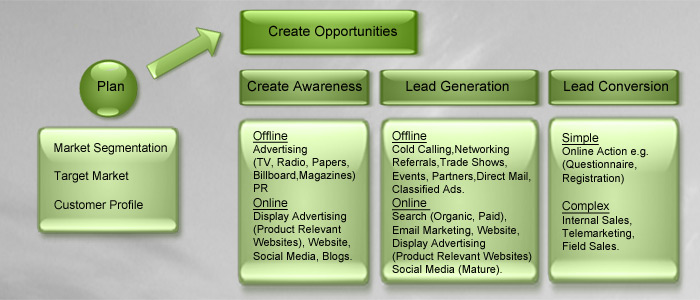
Digital (Online) Marketing integrated into the Sales Process
Digital Marketing allows niche markets to be targeted at a comparatively reduced cost.
Create Awareness
Use
- Display Advertising
- on websites that are relevant to the product being sold.
- Social Media & Blogs
- to engage with target market, to help educate and to announce new products.
- Email Marketing
- to distribute newsletters, whitepapers to stimulate interest.
- Website
- to educate.
Use in combination with Offline Marketing in the right blend to enhance success.
Generate Leads
Use
- Search (a mixture of organic and paid),
- Display Advertising (on websites that are relevant to the product being sold) &
- Email Marketing.
- Social media (networking and leads from engaged audience)
- Website (Capture inbound inquiries)
Use in combination with Offline Marketing in the right blend to enhance success.
Search has historically been the strongest digital channel for lead generation. It has been found that the yield is improved when combined with other channels such as Display Advertising.
Demonstrate Value using a Marketing Funnel
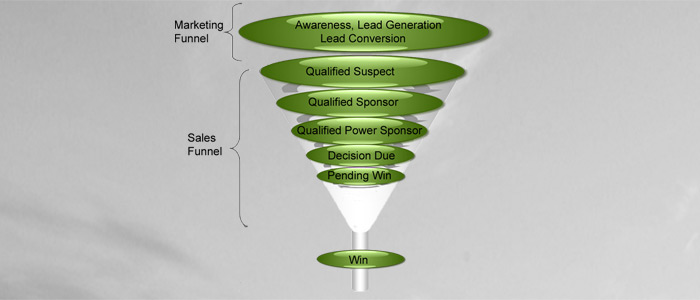
Use Marketing Funnel Above Sales Funnel to demonstrate Value
Whether you are B 2 B, B 2 C or non profit your marketing activities can be best viewed using the sales funnel.
Marketing at its heart is geared towards lead generation, but can also help in development and closure. The Value of any Marketing Campaign must be measured in the number of leads generated and opportunities created.
A Marketing Funnel may therefore be added above the Sales funnel. The exact breakdown of the Marketing and Sales Funnels will vary depending on the nature of the customer buying process. In general for B2B, the Marketing Funnel moves the target market members to Awareness, To Lead and To Converted Lead which then becomes an Opportunity for development by Sales. In Small Sales Teams, with no specialized Marketing help, this may well be all done by the sales team.
Demonstrate Value using an ROI Model
The actions to create a model are as follows:
- Map out a number of channels whereby a target company engages and becomes a lead, for example:
- Search Engine –>Main Site –>Download Whitepaper –>Registration
- Search Engine –>Blog–>Main Site–>Enquiry Form
- Twitter–>Blog–>Enquiry Form
- Facebook Fan page–>Main Site–>Enquiry Form
- Display Advertising Banner–>Product Microsite–>Main Site –>Enquiry Form
- Create KPIs and predicted relationships between KPIs and Leads generated, for example:
- Main Site Visitors
- Actions Performed (eg Download Whitepapers)
- Facebook Fans
- Twitter Followers
- Create Model
- Predict Customer sales
- Estimate Break down by Lead Generated and Path
- Estimate Costs
- Do Pilot Campaigns
- Compare Different blends and strategies
- Implement most successful on full market.
Initially, Social Media will be all about building awareness but if an engaged audience can be created then inevitably it will generate leads.
Social Media sites like Linked In are used by Sales Teams as part of their networking strategies.
Measurement and evaluation are very important. Every business is different and requires some testing to achieve the optimum blend of digital marketing channels.
Deliver Audience Engagement
The collateral benefit of Digital Marketing strategy is the creation and growth of engaged audiences (customers and prospects). A more engaged audience delivers the following benefits
- More Likely to purchase – A Mature engaged Social Media Audience can be a Lead Generation source.
- Better Retention – more likely to stay
- Brand Advocate leading to referrals and good references