
Posts Tagged ‘Sales Development’
Customer Service: The John Lewis Way

I recently had the pleasure of working inside John Lewis and experiencing first hand how they deliver customer service that’s admired. I enjoyed working with the company. The customers and staff (partners) are in general happy, very polite and helpful and the company has a great atmosphere which is a credit to them. This has not happened overnight. The trust that customers have in John Lewis takes a long time to build but much easier to lose. How have they created this? First are the founding principles of Customer Service in John Lewis –
“Be honest; give respect; recognise others; show enterprise; work together; achieve more.”
Then my impressions…
1. “We’re Based on the Notion that if we Treat our Partners well, it will lead to Good Customer Service.”
This is a simple idea but one few companies really put into practice. John Lewis implement it in a number of ways:
- Partnership
- Staff are called and treated as partners
- All partners are owners in the business and get a yearly bonus based on performance
- Managers served staff at Xmas lunch
- Partnership concept breaks down barriers and creates meritocracy
- Respect
- Respect for each other and for customers is a core value within John Lewis
- Managers and staff were generally very helpful to one another and to customers
- No difference between how customers and partners were treated…indeed partners were often customers
- Trust
- Trust partners and empower them to do well
- In general partners were given space to to their jobs and to succeed and
- Soft Benefits to create family effect
- Subsidised canteen, discount card, subsidised, sports , subsidised concerts, holiday homes etc…
- Social club with great parties etc.
2. Empower Staff
- Train staff well
- Empower them to make do the right thing. This may be asking a manager or acting on the customer’s best interests depending on the situation. They are encouraged to think outside the box once the basics have been understood and acted upon. Staff are expected to show enterprise in the right context
- Staff are product experts in their areas and have built up this expertise over time and through training.
- Be honest – if you don’t know do not waste the customer’s time. Find somebody with the right answer. Bring the customer to the answer if required.
3. Get and Act on Customer Feedback
- Headquarter staff spend a few days serving over peak periods. This helps to give better customer service overall but also gives them immediate insight into the problem areas that customers are facing.
- Staff are expected to communicate issues regularly and many forums are created whereby this is done in a formal way
4. Make Online and Store seamless
- Returns for online can be done in store at any till with systems work behind the scenes to improve this process ongoing. This can be much better than having to repackage it and post it back to other online retailers.,
- Maintain exceptional customer service online. Customers have access to people when they need it and can use Waitrose and John Lewis stores to pick up their purchase rather than missing the delivery at home.
- Online is becoming a huge part of the overall service offered by John Lewis allowing customers to purchase when stores are closed. The John Lewis Clearance sales started on Xmas eve.
5. Make Customers Life Easy
- Shopping can be stressful and unpleasant in the wrong environment. John Lewis try to help make it a pleasant environment.
- Create a calm environment that is pleasant to look at and products are easy to find. Do not overburden with selling messages in flash colours
- Keep queues to a minimum by hiring temporary staff for peak times to help at till as and free up existing staff to answer questions and give advice. Also deploy HQ staff to help out.
- Provide a customer collection point that will collect all customer purchases in one location to ensure that they are not overburdened with bags
- Provide home delivery options from store
- Provide delivery options to John Lewis or Waitrose stores
- Provide extensive gift list and gift wrapping services
- Staff are honest and if they cannot answer will say so but will find someone who can and will not leave the customer until they are assured that the customer is being served by someone able inside John Lewis.
6. Be Different
- Never knowingly undersold
- John Lewis will match competitor prices if evidence is presented that is relevant and reasonable.
- Staff are empowered to do this on the fly with manager’s approval.
- Systems will support on the fly one off discounting.
- Have an exceptional returns policy
- John Lewis customers are trusted implicitly and when they bring back a product that they are not happy with it is changed often without question. This could be abused but at a macro level this creates tremendous good will and indeed more purchases. Often customers need to see the product in the home environment before being really sure and if they could postpone or not purchase if the returns policy was too difficult.
- Have an exceptional warranty on electricals
- John Lewis provides market leading warranties on electrical items whilst maintaining competitive prices.. This has become more important a sthe options on the high street narrow.
7. Hire people who share the John Lewis vision
- Hire people who will take on the values of John Lewis and take it forward. The gatekeepers that hire staff into John Lewis have an important job to hire people that will not abuise the trust and respect gievn to them by partners and customers.
You’ve Gotta Laugh! – Humour in the Workplace

We laugh so often that we never stop to ask what is it for. In fact ask the question and the recipient will be waiting for the punchline (thinking it is a joke!). But in a business context what is humour for? Why do we have some of our best times when we enjoy a good laugh in a group? Are there negative aspects to humour? Why do we sometimes feel angry or hurt when in a group that are laughing at a joke – maybe at our expense?
Well, like many of the social tools we use, humour is such a part of our human interactions that we use it and react to it unconsciously. But where did it come from and where did it start?
Some scientists reckon that humour was originated to help with procreation.
Scientists have proposed a variety of evolutionary theories of humour that mostly boil down to getting an edge in the chase for a mate. American evolutionary biologist Richard D Alexander, for example, suggested in his 1986 book Ostracism and Indirect Reciprocity: the Reproductive Significance of Humour, that the point of telling jokes was to raise one’s own status, lower that of certain other individuals, and enhance social unity…..And to get laid.
In the work environment, status is important and humour is used with varying degrees of success to raise that of the joker and reduce that of the target. If you are the target of an experienced joker, you may be seething inside but will have to laugh along as you find it impossible to find enough ground to take issue. How many times have you thought up a witty riposte hours later and wished you could have used it.
Humour is sometimes used to make serious points and to communicate messages that the originator cannot or is afraid to communicate seriously. This a poor use of humour as again it may be divisive.
Humour for social unity is one that we all enjoy because it is inclusive and non divisive whereas status driven humour may be exclusive and divisive. Status humour about groups can include social unity as a by product but it applies to specific groups inhabited by the joker.
So use humour in the workplace to promote social unity, to release tension and create a friendly and enjoyable workplace.
Beware of humour that promotes individual status or agendas.
The Art of Persuasion
Communication is a fundamental part of business and personal life. We now have many different ways of communicating from face to face to phones, social media, print media and broadcast media.
With all of these communication channels we are trying to inform, persuade, motivate, coach and manage relationships.
I would like to review a very important element of commuication: the art of persuasion. And I will limit my focus to B2B communication (mainly).
Win:Win Framework
Communication is always within a context or framework which may be implicit or explicit.
For some the word persuasion has ominous undertones and a worry about being manipulated.
I am assuming, in this discussion, that persuasion is used within a framework that assumes a (win: win) or positive outcome for both parties.
I assume that what I am persuading the customer to do will add value to the customer’s business and result in a (win: win) transaction.
Basic Persuasion Model
A basic persuasion model was constructed by Aristotle and consists of three elements:-
- Credibility – relates to the character and reputation of the persuader.
- Emotion or Empathy – the persuader must have the the ability to identify and understand the other person’s feelings, ideas and situation.
- Logic – relates directly to the logic of the argument.
Appealing to Credibility
In appealing to credibility, both the individual and the company he represents must be credible in the eyes of the audience. He must emit true sincerity.
Genuine sincerity means that you actually care about someone’s problems or concerns. It creates a certain amount of trust. And trust is the foundation of relationships.
The company builds its credibility on its successes and on its third party references. (In the B2B mainstream market (Early & Late Majority) positive references are key to credibility.)
The individual builds his individual credibility with integrity, historical success (supported by knowledge), skills and experience (as required by the audience). Initially the company brand will lend credibility to the individual but the individual must build and maintain his own over time.
In launching new products the phrase “Credibility before Visibility” is very apt. A lot of marketing and sales expense may be wasted in persuading the market to buy products that are not yet credible in the eyes of the target audience.
Appealing to Emotion
This using your heart as well as your head. It’s the ability to read emotions in others. It’s being able to experience from another person’s perspective. It is empathy.
It appeals to the emotions, imagination and self interest in the audience. In some cases to feel what the presenter feels.
The message evoking an emotional response may be delivered by words, messages but also by non verbal communication. The words may well be in the form of a story, a vision that transports the audience to understand the presenter’s point of view or to join him in envisioning the a particular part of the world as improved or as a better place. Music, colours, films, graphics etc. may be used to emphasize and communicate the required message.
Non verbal communication can give wither a positive or negative response. Such communication is delivered via facial expression, eye contact, gestures, posture and body orientation, humour, proximity, paralinguistics (tone, pitch, rhythm, timbre, loudness and inflection of voice), dress sense, attitude & confidence.
Emotion also includes building a relationship and a rapport that can reduce barriers to communication and engender trust which is a foundation of all human intercourse.
Appealing to Logic
Persuasion Techniques
Whilst techniques can be used to persuade they are most effective when supported by the persuasion model above. These techniques include structure, body language, speech, maintaining attention and the darker arts of weapons of influence.
Structure
- Introduction – Frame the topic. Prepare audience to be receptive.
- Narrative – a story in a form that is relevant to the audience that tells what you want them to do.
- Argument – proofs and supporting logic.
- Refutation – anticipate objections to the argument.
- Conclusion – appeal to the audience for understanding, its action and its approval.
Body Language
- Facial expressions
- Gestures
- Open or Closed Body Signals
- Spatial relationships – how close we are to our audience.
Speech
- Volume
- Rate of Speaking
- Tone, pitch and inflection.
Maintain Attention
If the audience is not paying attention you are not communicating, there is no communication and no persuasion can occur. Attention is best if it rises over time.
Most people have short attention spans.
Make the message memorable and understood.
- Say what you’re going to say. Say it.Say what you said.
- Keep it short 15 mins is optimal.
- Avoid distractions, interruptions and breaks
- Avoid large disagreements to what you say by ensuring that key members of the audience have been persuaded before the presentation.
Weapons of Influence
We have automatic behavior patterns that we use to simplify the modern world and enable action and void being frozen by too much analysis. These behaviour patterns make us vulnerable to persuasion by those who know how they work. These weapons of persuasion are part of thee dark arts of persuasion in that they do not always result in a win:win situation if used unscrupulously. In B2B selling , professional buying processes are designed to minimize or remove the impact of these weapons but they are used often in B2C selling.
We live in an extraordinarily complex and stimulated environment, easily the most rapidly moving and complex that has ever existed. To deal with it we need shortcuts. We can’t be expected to recognize and analyze all the aspects in each person, event and situation we encounter in even one day. We haven’t the time, energy or capacity for it. Instead, we must often use our stereotypes, our rules of thumb to classify things according to a few key features and then to respond mindlessly when one or another of these trigger features is present. Sometimes the behaviour will not be appropriate for the situation. But we expect the imperfection since the alternative is that we would be left frozen, analyzing and miss the time for action.
According to Alfred North Whitehead “civilization advances by extending the number of operations we can perform without thinking about them”. These are the key weapons.
- Reciprocity – “One good turn deserves another…”
- People are more likely to give to you if you have already given to them
- Commitment & Consistency – “Stay on course!”
- We have a nearly obsessive desire to be consistent with what we have already done.
- If I can get you to make a commitment (that is to take a stand, go on record), I will have set the stage for your automatic and ill-considered with that commitment. Once a stand is taken, there is a natural tendency to behave in ways that are stubbornly consistent with the stand.
- People are more likely to behave the way you want them to behave if they believe that this behaviour is consistent with an existing commitment
- Social proof – “Monkey see, monkey do”
- People are more likely to follow a particular course of action if they see other people doing the same thing
- Authority –
- People are more willing to follow instructions if the perceive the instructor to have authority or expertise
- Likeability – “Jobs for the boys”
- People give preferential treatment to those that they know and like
- Scarcity
- Rare items and opportunities are much more attractive than commonplace equivalents.
Using Value to Sell Complex Services

Value must be recognised by the customer - use his rules.
Selling Complex Services
Services are invisible, intangible so how best to sell them?
By describing clearly the value that they can bring to the customer.
This is done by estimating the value to the customer, the investment required and describing how a customer reference has received similar value .
Value Proposition
The delivery vehicle for communicating value is known as a value proposition and can be used for all kinds of sale but is particularly useful for complex services sales.
It is normally used initially in prospecting to get the attention of an executive and to get agreement from him to assign resources to work together on an evaluation plan. This will include the creation of a detailed business plan to ensure that it is the right decision for the company.
Simple Example
A very simple value proposition example using the services offered by O’Brien Business Solutions is shown below.
We believe that Customer A should be able to
- Achieve Business Growth by a minimum of 15% in the next year
Through an ability to:
- Launch New Products and Services
- Create a New High Performance Sales Team
- Win New Breakthrough major Accounts & create positive references
- a Business Solution designed and implemented to deliver delivering Sales and Marketing programmes.
- £YK.
- an 1 year contract and a start within 2 weeks.
- a similar Business Solution to Customer Reference A where a Business Growth of 20% was achieved in the same timeframe.
A more complicated BPO example
We believe that Company A should be able to
- Increase efficiency by 10% resulting in a 5% increase in profits per annum.
- With an upside of
- Improve knowledge sharing, security and workforce effectiveness
Through the ability to
- Design and implement new business processes using the latest technology
As a result of
- Outsourcing specific document intensive processes in HR, Legal & Supply Chain departments
For an investment of
- Set up – £XM set up
- Ongoing – Annual Service charge of £YM
Based on the following Assumptions
- 5 Year contract
- Set up in Yr 1
- Relevant staff transferred according to TUPE.
- Benefits realized in years 2-5.
Best relationships are based on value
Value is referenced throughout the sale. It may well start with a straw-man, built using data from a previously successful customer or reference and extrapolated to address this particular customer. It will be developed as the sale proceeds as more detail on the solution is developed and information on the assumptions is discovered. In some cases, some pilots may need to be implemented to test some key assumptions in the value equation.
The best relationships in business have the delivery of value as their foundation. A sales person that is perceived to consistently deliver value (advice, information, solutions) will be better placed to form better relationships.
Value flows throughout the organisation
For instance the CEO may have an objective of increasing the average revenue per user. This will be come a lead generation objective by the marketing department and an opportunity conversion objective by sales. A Value chain may be created to move from clearly known objectives at the top of the organisation to create new ones lower down the organisation.
Selling Complex Services into the Early Market
Selling into the Early Market is characterised by no or very limited customer references that will underpin the value proposition.
Whilst the Early Market is also characterised by buyers that are more innovative and as such prepared to take a risk, they do need some rationale for taking a decision to proceed.
Services do have more difficulties here than say selling a product like a piece of equipment in that a piece of equipment can be tested by a third party and the benefits verified.
Complex services such as BPO require at least one customer reference before the value proposition mat be truly verified. And as such it underlines how important the customer references are and therefore it is worth the company putting a lot of resources into obtaining the first contract an delivering it. It is worth noting also that it will take time before the benefits can be calculated and therefore will take time before the contract can become a true customer reference.
What can be done in the absence of a customer reference? A number of options can be explored:
- Start with a good relationship and trust as a foundation?
- Can you use process that is being done inside (selling) company’s own organisation?
- Does the new process utilize a core competence of the (selling) company? For instance a new technology that will improve the process. Examine its use in customer processes and obtain results.
- Utilize Market research to verify the value proposition.
There are two methods to achieving the market research:
- Find market research by a respected third party that will verify the claims made in the value proposition.
- If adequate market research is not available then conduct bespoke market research that will verify the claims made in the value proposition.
Lead with Value, Close with Value
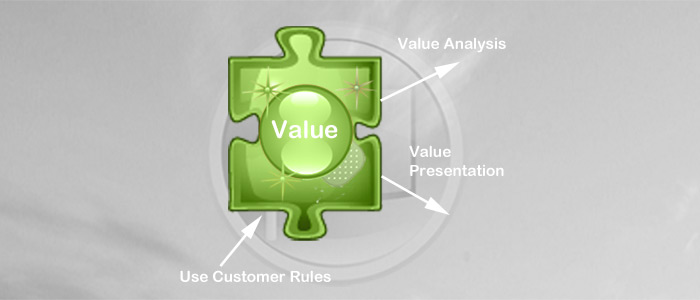
Best Relationships are based on Value
Best practice dictates the sale is opened, driven and closed with Value. Value must be described in terms that are relevant to the customer. The Value proposition normally includes (i) the delivery of a tangible customer goal, or the resolution of a customer issue or pain in clear quantifiable terms (ii) for an acceptable investment. Or in other words: Value = Total Benefits – Total Investment.
An example:-
” We believe that Company A should be able to
- Increase Average Revenue Per User from £22 per month to £26 per month resulting in an increase in profits of £5M per annum within the first year.
Through the ability
- To offer new data services
As a result of
- A network expansion and the creation and launch of a new data service
For an investment of
- £3M.
Based on the following Assumptions
- 3 new Network Nodes costing £2M.
- Network Management System £500K.
- Marketing Plan costing £500K.”
Value is referenced throughout the sale. It may well start with a straw-man, built using data from a previously successful customer or reference and extrapolated to address this particular customer. It will be developed as the sale proceeds as more detail on the solution is developed and information on the assumptions is discovered. In some cases, some pilots may need to be implemented to test some key assumptions in the value equation.
The best relationships in business have the delivery of value as their foundation. A sales person that is perceived to consistently deliver value (advice, information, solutions) will be better placed to form better relationships.
A Goal/Objective for the CEO flows down to the CMO and down to the marketing department.
For instance the CEO may have an objective of increasing the average revenue per user. This will be come a lead generation objective by the marketing department and an opportunity conversion objective by sales. A Value chain may be created to move from clearly known objectives at the top of the organisation to create new ones lower down the organisation.
Creating a High Performance Sales Team: – Hiring

The foundation for creating a high Performance Sales team is hiring the right Sales People
A key to success is to create a professional hiring process. This means that the role well defined and the process very professional. It will recognise, target and attract sales people with the potential to be high performers. Good people always have options so they must be sold to. Potential high performers are attracted by the the right company culture and its reward system.
The reward system includes monetary items but also many soft items such as job satisfaction growth prospects and status.
Creating a High Performance Sales Team: – Sales Model
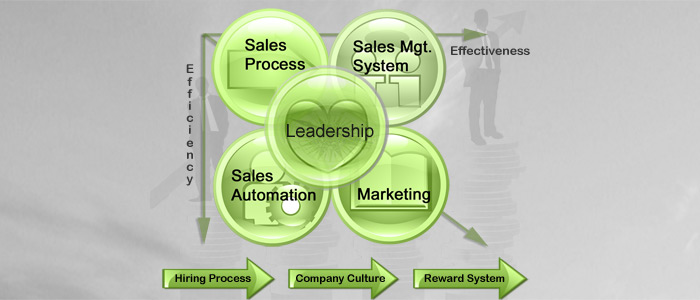
Use Sales Model with Leadership to create high performance culture
A High Performance Sales team is created by combining good hiring of sales people with Leadership with a scalable sales model.
The sales model will improve efficiency and effectiveness by implementing:-
- A Sales Process (Increases efficiency and effectiveness)
- A Sales Management System (Increases effectiveness with some efficiency)
- A Sales Automation System (Increases efficiency with some effectiveness)
- Integrate Marketing (Increases efficiency and effectiveness)
High performing sales people (stars) have a unique combination of skills and knowledge. They excel at building customer relationships, developing successful strategies, managing internal resources and beating their targets every year. A sales model will take the best of these skills and experience and turn an average sales person into stars.
Read more at Sales Model.
Creating a High Performance Sales Team: – Leadership
 Leadership, when added to a scalable sales model and the hiring of high potential sales people will create a high performance sales team.
The following are the key elements of leadership that through experience we have found it valuable to focus on.
- Inspire Trust
- Create Motivation
- Remove Hurdles and Barriers to Performance
- Foster Individual Growth.
Read more at Leadership.
