
Posts Tagged ‘product marketing’
Product Management vs Product Marketing Activities
Titles really are a mess. What one company calls a product manager, another calls a product marketing manager. It is best to be aware of this and to focus on the activities required. Also where these people do not exist in an organisation other departments fill the void. So the activities may be performed (poorly) by technical, sales, operations or marketing communications.
Typically the title “product manager” is used to signify people who listen to the market and articulate the market problems in the form of requirements. And the title “product marketing manager” is usually assigned to those who take the resulting product to the market by defining a product marketing strategy.
In Crossing the Chasm, Geoff Moore defines (and recommends) two separate positions:
A Product Manager (PM) listens to the market
 “A product manager is a member of either the marketing organization or the development organization who is responsible for ensuring that a product gets created, tested, and shipped on schedule and meets specifications. It is a highly internally focused job, bridging the marketing and development organizations, and requiring a high degree of technical competence and project management experience.”
A Product Marketing Manager (PMM) talks to the market
 “A product marketing manager is always a member of the marketing organization, never of the development group, and is responsible for bringing the product to the marketplace and to the distribution organization… it is a highly externally focused job.”
In reality, there is a blurring of activities and the captions used (talking and listening) are used for simplicity, clarity and guidance rather than laws. The activities performed by the roles are as follows:
Product Management Activities
- Define Market Opportunity,
- Define User Personas for individual products.
- Create Product Requirements & Use Scenarios,
- Analyse Competitive Landscape,
- Define Product Differentiation & Position Product,
- Create Business Case, Acquire Funding,
- Create Product Roadmap, Develop Product,
- Launch Product, Manage Product Lifecycle.
Product Marketing Management Activities
- Articulate Product Objectives,
- Articulate Product detail ( differentiation, positioning, applications, pricing and USP), Understand Market (needs, problems,& segmentation, priority, size, customer profiles and purchase processes),
- Understand Competition,
- Build Go to Market plan ( value proposition, sales process, select/create sales channels and objectives, message map, demand generation strategy, promotion strategy, sales guide, sales support & collateral, sales training, pipeline management, metrics, systems, budget, schedule),
- Execute Plan ( launch event, launch team).
- Conduct Win/Loss analysis.
Director, Product Strategy Activities
In organisations where a Director, Product Strategy exists then they may take on more of the strategic and less tactical activities.
- Discover and validate market problems (both existing and future customers)
- Seek new market opportunities by leveraging the company’s distinctive competence
- Define and size market segments
- Conduct win/loss analysis
- Determine the optimum distribution strategy
- Provide oversight of strategy, technical, and marketing aspects of all products in the portfolio
- Analyze product profitability and sales success
- Create and maintain the business plan including pricing
- Determine buy/build/partner decisions
- Position the product for all markets and all buyer types
- Document the typical buying process
- Approve final marketing and go-to-market plans
Sales Problems may point to poor Product Management & Product Marketing
Sales problems are very visible.

Targets are not met. Customers are not acquired. Pipelines are not healthy. Forecasts are not met.
Often the immediate reaction is to blame the sales personnel. Typical questions are: Are they working hard enough. Are they working smart enough? Do they have the right relationships. Are they looking in the wrong places. Do they understand customer problems? Do they understand the product value? Can they present the value of the product effectively?
Diagnose, Create & Deliver

While sales personnel can always up their game, in many cases the root problems can be elsewhere. If Product Management and Product Marketing processes been ignored, or not done correctly then the following problems may be diagnosed
Diagnosis
- Do product differentiators exist and are they understood?
- Is product positioning clear and understood?
- Have the correct target market segments been identified?
- Is the product fully developed and bug free?
- Does the product provide the whole solution for the customer or are partner products required?
- Is the product perceived as too expensive?
- Is the value of the product understood and presented well enough?
- Are the value messages available for all of the key players in the customer organisation?
- Do suitable message vehicles exist? Do sales tools exist?
- Are there reference customers available that are acceptable to target customers?
Create & Deliver Solution
A solution must then be created and delivered. Depending on the organisation this may be done by Product Management and Product Marketing.
Product management is inward focussed and product marketing is outward focussed.
- Utilise Differentiators – Articulate product differentiators, and combine with customer profiling and competitive analysis to position products correctly and to drive messaging.
- Prioritise Target Customers – Utilise market analysis and product positioning to prioritise demand generation and sales activities
- Finalise Development – Create project plan and obtain high level management sponsorship to finalise development.
- Create Whole Solution – The construction of the solution may be done directly or via a third party such as an integrator. In Early markets the customer will normally provide this function either directly or via a third party.
- Execute Pricing Review – Ensure that value is demonstrated clearly by better presentation or if required a pricing reduction or re-organization.
- Create Better Value Presentation – Include all the value elements and simplify presentation in line with the customer financial modelling. Include as a standard sales tool.
- Acquire Reference Customers – Provide sufficient support to sales personnel to target and acquire reference customers.
Project management methodologies and tools can be used as appropriate to deliver solutions efficiently and effectively.
Achieving Business Growth

Challenge
The overriding challenge in sales and marketing is “To deliver business growth”.
How to Address
Take the right approach.No one size fits all. So to be most efficient and effective it is best to:
- Diagnose Challenge,
- Create Solution & then
- Deliver Results.
The challenges will fall into two broad categories
- Enter new markets or
- Develop existing ones.
Diagnose Challenge
The main ingredients of success are:
- Strategy,
- Sales team (& infrastructure),
- Customer acquisition( tailored sales process, product value, & customer references)
Create Solution
Following the diagnosis of the challenges a bespoke solution may be created.
Create/Develop Strategy
Planning means that subsequent action will effective and efficient.
- Create customer profile,
- Value proposition,
- Go to Market strategy,
- Sales process,
- Sales team,
- Targets.
Create/Develop Sales Team
This includes Leadership, Scalable Sales Model and Hiring the best people.
Leadership means that the team energised, have clear objectives, are fully engaged and deliver the required targets wit the required cost. The team is supported by a scalable sales model which includes:
- Sales Process based on Customer Buying Process
- Sales Management System to to deliver forecasts and processes for coaching and performance management
- Sales Automation that improves the efficiency of communication, customer database and reporting.
- Marketing Integration for lead generation, sales tools, messaging and effective market coverage.
Hire the best people. Utilise a clear and professional process to identify and develop people with high potential.
Begin/Develop Customer Acquisition
Customer Acquisition is vital for revenue Growth and the creation of references to enable later customers to be acquired more efficiently. Both are key attributes of business growth.
First ensure product delivers compelling value. as perceived by the customers. Then create or develop references.
To win major breakthrough accounts will require the creation of a tailored sales process based on the customers buying process. This will help harness the resources of the company effectively, manage communication and monitor progress.
Deliver Results
Results will be best delivered by effective leadership and professional project management.Leadership ensures that clear objectives are set and resources to deliver such objectives are secured.Then the team to deliver the results is engaged such that they are fully committed to deliver superb results.Finally the results are delivered with progress monitored and reported on at regular intervals to keep stakeholders informed.
Creating Customer Solutions
Understand: the Customer’s Business Model
A business model is made up of the following elements:
- Customer Segments Served: Who are they creating value for? Who are their most important customers?
- Value Propositions: What value are they delivering to customers? What customer’s problems are they helping to solve? Which customer needs are they satisfying?
- Channels to Market: Through which Channels do their Customer Segments want to be reached? How are they reaching their Customer Segments now?
- Customer Relationships: What relationships do each of the customer segments expect? What ones have been established? How costly are they?
- Revenue Streams: What value are customers willing to pay and what are they currently paying?
- Key Resources: What key resources are required by Value Proposition, Channels, Customer Relationships & Revenue Streams?
- Key Activties: What key activities are required by Value Proposition, Channels, Customer Relationships & Revenue Streams?
- Key Partnerships: Who are their Key Partners & Key Suppliers. Which Key Resources are they acquiring from partners? Which Key Activities do partners perform?
- Cost Structure: What are the most important costs inherent in the business model? Which Key Resources are the most expensive? Which Key Activities are the most expensive
Diagnose: Pain Points
Diagnose where the customers pain points are in their business model:
- Find new customer segments?
- Create new value propositions?
- Reach customers more effectively?
- Increase Revenue Streams?
- Provide new key resources or key resources with better attributes?
- Increase key activities efficiency?
- Replace one of their key partners?
- Reduce cost structure ?
Create: Solution
Create a solution:-
- Define benefits
- Define investment
- Demonstrate capability using references and endorsements
- Communicate in customer’s language showing Return On Investment.
Communicate: Solution
Resolve concerns on solution, risk and price.
Communicate in customer’s language showing Return On Investment.
Deliver: Solution
Deliver the solution.
Use project management tools to manage delivery.
Demonstrate that benefits have been delivered. Ensure customer satisfaction.
Sales Leadership
What is leadership? What is the purpose and function of the leader? It is to deliver business growth and is achieved by 1-Set Objectives, 2-Engage & 3-Deliver.

Leadership
Leadership
The sales leader purpose is to deliver business growth and leads both direct and virtual teams to achieve this objective. Leadership is therefore key to business growth success.
Aristotle defined leadership as requiring Knowledge, Skills and Practical Wisdom – the ability to see the good and realize it in a specific situation. All three are necessary and mutually supportive.
Montogomery defined leadership succinctly as:
“The capacity and will to rally men and women to a common purpose and the character which inspires confidence”.
The purpose in an organisation has multiple levels. The company will normally have a vision which states why the company exists and how it will make the world a better place.
The sales team itself has a specific purpose that serves the achievement of this vision and as such will have specific objectives. The sales leader’s overall purpose is to deliver business growth. This is achieved as follows:
- Set achievable but challenging Objectives (or targets) within the context of the vision of the organisation.
- Engage his team to accept these objectives wholeheartedly and in good spirit and then to
- Deliver the performance necessary to achieve these objectives.
Leadership Model
Leadership is not fixed and is dependent on the task at hand. It is also dependent on the type of organisation whether transformational or transactional and on the maturity of the organisation. But I find the following simple model of leadership useful.
A leader requires Knowledge, Skills (&Tools) and Practical Wisdom.
 Practical Wisdom
Knowledge may be learned, Skills may be practiced but Practical Wisdom is grown through through experience and reflection. Practical Wisdom is the ability to see the good and realize it in a specific situation. In other words to decide and do what is effective to achieve the required objectives.
This is not a set of universal rules to be learned or a pocket guide to be drawn upon for the correct solution. It is something only achieved through experience and reflection. It is realized through the ability to relate new experiences to previous experiences, in other words to recognize patterns in situations that facilitate understanding and resolution.
Practical wisdom is supported by the qualities of the leader.
The following list is in a generic order of priority. It is derived from the book “ How to Grow Leaders” by John Adair.
- Enthusiasm. A leader must demonstrate unquenchable enthusiasm for the achievement of the agreed goal.
This may be quiet and slow-burning enthusiasm rather than the heat and fireworks of passion, but it is always there. - Integrity. The quality that engenders trust. Trust is the foundation for all human intercourse.
- Demanding – coupled with Fairness. A leader has high standards and will not compromise on them.
But is also consistent, fair and will not ask of others more than he asks from himself. - Humanity. The raw material with which a leader has to deal with is people and must understand them and go with the grain.
- Confidence. No leader can operate without a quiet confidence.
- Humility. The result of having a proper sense of one’s own limitations.
Its hallmarks are a readiness to listen and to be taught, a willingness to admit when one is wrong, and a reverence for others. - Courage. Demonstrated by doing what is right, because the leader believes it to be right and despite criticism.
 Knowledge & Skills
The knowledge and skills required may be described as:
- (1) situational skills and knowledge i.e. those relating to the particular situation which in this case is sales
- (2) generic leadership skills.
Situational Knowldege and Skills
Good Sales & Marketing knowledge & skills are the most obvious. General Management knowledge & skills enable better empathy and good communication with senior customer executives.
Project Management knowledge & skills enable better management of internal resources, better bid management and better planning. Technical knowledge & skills enable better understanding of products and how they can best be used to solve customer problems.
Skills will be supported by tools such as the sales model which enables:
- Performance monitoring,
- Performance appraisal,
- Close performance gaps through coaching and training.
Leadership Knowledge and Skills
Leadership knowledge & skills include:
- Defining Goals and Objectives
- Planning
- Communication
- Motivation
- Coaching
- Evaluation
- Execution
Purpose & Function
The Purpose of a sales leader is to deliver business growth. This is achieved as with the following functions:
 1 – Set Objectives
A key purpose of a leader is to set objectives that will grow, change and add value to the organisation.
Objectives should not be dictated as they are unlikely to inspire the kind of effort and creativity that produces good results.
Objectives that are negotiated give team members an important sense of goal ownership. And people are naturally more committed to the things they own.
In addition, with this interaction the leader can be sure that the team members have the capacity and the understanding to achieve the objective. Understanding team members will help align objectives and explain them in ways that are motivational.
To set effective objectives a leader must be able to initiate an idea, inform the team and plan to determine if the objectives are feasible.
What are the characteristics of effective objectives? Most experts agree that objectives must be:
- Specific ( Greater as we go down levels. Sales persons objectives are often very specific)
- Clear
- Important (Recognised by team member as important)
- Measurable
- Achievable (But challenging)
- Time-bound (To be achieved in a specific time)
- Aligned (To company Strategy)
- Rewarding (Supported by appropriate awards)
- Ethical
- Resourced
Objectives will be better received by the team if they are perceived to have intrinsic value, to matter,
and to make the world a better place. Ideally the objectives will be aligned to a company vision statement that envisions and communicates a better future.
 2 – Engage
The leader may be required to hire the individuals and build the team. The leader is required to develop the individuals such that their performance improves.
Further, a leader must engage with his team and inspire them to want to deliver a great performance and achieve the assigned objectives.
In the best teams the whole is greater than the sum of the parts. Good morale, team spirit and mutual confidence between the leader and team members is the extra strength that creates a greater whole and inspires a great performance.
To engage his team effectively a leader must be adept at presenting, informing & supporting.
Engagement begins with participative goal setting ideally within the context of a positive and clear company vision statement. This is maintained through motivation, coaching and success. Success is the greatest single factor of good morale. All successes must be communicated.
Motivation is achieved through the application of rewards both intrinsic and extrinsic. Intrinsic rewards produce more intangible forms of recognition such as personal satisfaction, a sense of accomplishment, personal control over one’s work and feeling that one’s work is appreciated. Extrinsic rewards are external, tangible forms of recognition such as bonuses, pay rises, promotion and sales prizes.
- Extrinsic – Financial Rewards
- Bonuses, Commission & Salary Increase.
- Extrinsic – Prestige Rewards
- Increase stature of employees in eyes of colleagues and others
- Intrinsic – Job Content Rewards
- Autonomy (Goal Setting participation, Increased Responsibility, Opportunities to participate in Decision Making),
- Mastery (Grow Professionally and do interesting and important work, Training, Coaching, New Challenge, Working with talented motivated people,
Recognition), - Purpose (Working in a company with a clear Vision, Making a Difference),
- Valued (Trust, Feedback, Coaching, Working in a positive respectful environment,
Working for a Good Boss)
Coaching is used to improve individual performance and to remove performance gaps. Used positively it can maintain and grow engagement as it facilitates individual personal growth.
Within a sales team focus is normally on extrinsic rewards but intrinsic rewards are very important and enable better performance and creativity.
 3 – Deliver
A leader is ultimately judged on what he and his team deliver. How they execute a plan.
To deliver a leader is required to:
- Achieve the task.
- In a sales environment this is normally business growth measured by revenue growth, margin growth, market share growth, customer satisfaction and sales cost.
- Build and develop the team.
- Develop the individual.
The leader uses the sales model to enable him to:
- Monitor performance – Sales process, sales automation and sales management system.
- Appraise performance – Appraisal system.
- Close performance gaps – Coaching and training. Employee development.
- Handle problem employees.
- Remove barriers to performance.
Team members work best when given autonomy to deliver their goals and should know when to ask for help in removing barriers to performance. Identifying barriers to performance may be simple or may involve gathering data and problem analysis before a solution is reached. Barriers to performance often include the requisition of resources from other departments & from higher management to enable progress. They may include the resolution of a resource conflict or an interpersonal conflict.
As stated earlier the sales leader may be required to manage a virtual team in addition to his direct team to create and deliver a proposal to a prospect. Such a project may be complex and project management tools are useful to manage the delivery of a winning proposal on time and to utilise the resources of the company efficiently.
3 Step Plan to Deliver Business Growth
- Step 1: Diagnosis – What are the Business Challenges? What are the growth objectives? What is the current sales and marketing infrastructure and what needs to be provided?
- Step 2: Design – How can Business Growth be achieved? Design the Solution
- Step 3: Implement & Report.
Step 1: Diagnosis
“Diagnose before you Prescribe”. Covey.

Diagnose Business Challenges to create Solution
If the diagnosis is not correct then the solution may well be inappropriate or incorrect.
What are the Business Challenges?
- What are the Growth Objectives and supporting Business Plan?
- Is New Market Entry required –
- Early (New Products to Market),
- Mainstream (Moving from Early Adopters/Innovators into broader Mainstream market or
- Geographic?
- Is Development of Existing Market required?
- Does a Business Development/Improvement Plan exist?
- Does an acceptable Sales Strategy exist?
- Does a Sales Team exist that is fit for purpose?
- Create, develop or radically improve?
- Is the sales infrastructure sufficient (Hiring Process, Reward System, Sales Process,Sales Management System & Sales Automation system)?
- Is Marketing Support sufficient and integrated with sales (Sales Tools, Sales Training, Lead Generation, Market Coverage)?
- What Major Accounts are required?
- Do references exist?
- Is there sufficient support infrastructure (Tailored Sales Process)?
Step 2: Solution Design
Having diagnosed and agreed the Business Challenges in detail, the Solution may now be designed. Depending on the Business Challenges the Solution will include some or all of the modules.

Choose Solution to fit Challenge
- Create Strategy
- Create New Sales Team
- Win New Major Accounts
- Create New Sales Team
- Win New Major Accounts
Sales & Marketing Strategy. This is designed to deliver Business Growth and other Objectives

Sales (& Marketing) Strategy
Use information on customer profile, geographic profile, product maturity, the competition and the strength of the vendor to shape the strategy. Develop Value Propositions as required to suit the particular product and customer profile.

Create a High Performance Sales & Marketing Team

Win Breakthrough Major Accounts
Step 3: Implementation
- Limited Resources
- Immature Infrastructure
- Customer Expectations too high
- Product Development Required
- Solution Development Required
- Partner Management Required
Lead Generation Terminology
Target Market
The Target Market or Target Market segment is a list of companies (B2B) or consumers (B2C) that possess the required buyer profile that make them pre-disposed to buy the product.
Territory
A territory is a part of the target market which has been allocated to a sales person or sales team.
A Lead
A lead is a potential opportunity sometimes known as a prospect – For example, a person met at a conference who expressed interest, or someone who filled out a form on the company website.
Lead Conversion (Or Qualification)
If the lead is qualified and the salesperson and decides to pursue it, the lead is “converted,” and becomes an opportunity. ( Note that the term conversion is used somewhat loosely and in many cases in Digital Marketing does not end up with an opportunity but with a (more qualified) lead that still requires further qualification before it becomes an opportunity.
An Opportunity
Opportunities are the sales and pending deals that are tracked in that Sales Pipeline or Funnel. The pipeline is built by adding more opportunities will contribute to the forecast.
Opportunity Qualification
Opportunity Qualification means that the prospect has provided information and performed certain actions that show that they are at a minimum in the market for the product, have the budget to buy and are willing to do so within a reasonable timeframe.
Qualification is tailored to the specific sales process which is itself aligned to the specific buying process in place.
In a simple B2C eCommerce transaction the qualification is a very simple process.
In B2B solution selling the qualification is a process that may be spread over weeks or months that forms a large part of the sales process due to the relative complexity of the buying process.
For instance in B2B solution selling:
- A Lead may be qualified initially by an internal telemarketing team who may deem it good enough to pass on to the field sales team.
- The Field sales team would initially qualify the company known as a suspect to avoid confusion with the term prospect. At this stage it would enter the funnel as a qualified suspect.
- Further levels of Qualification would then take place with the other members of the buying team such as the Sponsor (Person Driving the Project) and the Power Sponsor (Normally at Executive or C Level).
An Account
An account is the company or consumer that makes the purchase. An account may deal with several opportunities.
Digital Marketing Strategy
Build Foundation for Success
The key to success is to create:
- Clear Value objectives (or Clear Return on Investment objectives or Business Case)
- Clear measurement (“You can’t manage what you don’t measure”)
Value = Total Benefits – Total Investment.
Deliver Value
The Value delivered by a Digital Marketing Strategy is:
- Customer Sales
- Part or all of the sales process depending on sale complexity.
- For Complex B2B Digital Marketing can:
- Create Awareness & Stimulate interest,
- Generate Leads
- Audience Engagement
- Customer/Market Insight
- Is the market aware, Ready to buy? Are my customers satisfied?
- Used for Product Development or to Gauge the Appropriate Sales & Marketing Strategy.
This post will focus only on Customer Sales & Audience Engagement.
Deliver Customer Sales
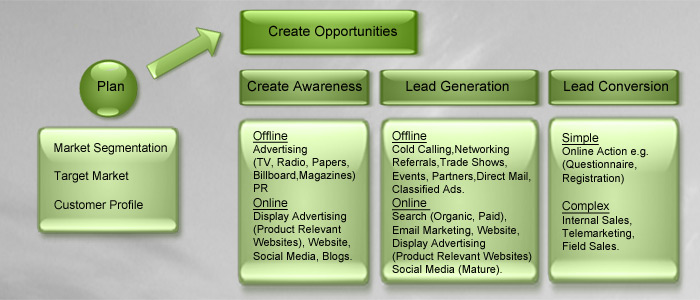
Digital (Online) Marketing integrated into the Sales Process
Digital Marketing allows niche markets to be targeted at a comparatively reduced cost.
Create Awareness
Use
- Display Advertising
- on websites that are relevant to the product being sold.
- Social Media & Blogs
- to engage with target market, to help educate and to announce new products.
- Email Marketing
- to distribute newsletters, whitepapers to stimulate interest.
- Website
- to educate.
Use in combination with Offline Marketing in the right blend to enhance success.
Generate Leads
Use
- Search (a mixture of organic and paid),
- Display Advertising (on websites that are relevant to the product being sold) &
- Email Marketing.
- Social media (networking and leads from engaged audience)
- Website (Capture inbound inquiries)
Use in combination with Offline Marketing in the right blend to enhance success.
Search has historically been the strongest digital channel for lead generation. It has been found that the yield is improved when combined with other channels such as Display Advertising.
Demonstrate Value using a Marketing Funnel

Use Marketing Funnel Above Sales Funnel to demonstrate Value
Whether you are B 2 B, B 2 C or non profit your marketing activities can be best viewed using the sales funnel.
Marketing at its heart is geared towards lead generation, but can also help in development and closure. The Value of any Marketing Campaign must be measured in the number of leads generated and opportunities created.
A Marketing Funnel may therefore be added above the Sales funnel. The exact breakdown of the Marketing and Sales Funnels will vary depending on the nature of the customer buying process. In general for B2B, the Marketing Funnel moves the target market members to Awareness, To Lead and To Converted Lead which then becomes an Opportunity for development by Sales. In Small Sales Teams, with no specialized Marketing help, this may well be all done by the sales team.
Demonstrate Value using an ROI Model
The actions to create a model are as follows:
- Map out a number of channels whereby a target company engages and becomes a lead, for example:
- Search Engine –>Main Site –>Download Whitepaper –>Registration
- Search Engine –>Blog–>Main Site–>Enquiry Form
- Twitter–>Blog–>Enquiry Form
- Facebook Fan page–>Main Site–>Enquiry Form
- Display Advertising Banner–>Product Microsite–>Main Site –>Enquiry Form
- Create KPIs and predicted relationships between KPIs and Leads generated, for example:
- Main Site Visitors
- Actions Performed (eg Download Whitepapers)
- Facebook Fans
- Twitter Followers
- Create Model
- Predict Customer sales
- Estimate Break down by Lead Generated and Path
- Estimate Costs
- Do Pilot Campaigns
- Compare Different blends and strategies
- Implement most successful on full market.
Initially, Social Media will be all about building awareness but if an engaged audience can be created then inevitably it will generate leads.
Social Media sites like Linked In are used by Sales Teams as part of their networking strategies.
Measurement and evaluation are very important. Every business is different and requires some testing to achieve the optimum blend of digital marketing channels.
Deliver Audience Engagement
The collateral benefit of Digital Marketing strategy is the creation and growth of engaged audiences (customers and prospects). A more engaged audience delivers the following benefits
- More Likely to purchase – A Mature engaged Social Media Audience can be a Lead Generation source.
- Better Retention – more likely to stay
- Brand Advocate leading to referrals and good references
Digital Marketing is Now Mainstream
Value Delivered is Nothing New.

The value delivered by Digital (or Online) Marketing is nothing new. It delivers, or helps to deliver:
- Insight into customer requirements
- Customer Sales
- Customer Service
Digital Marketing uses the internet which has taken market share from Newspapers and other traditional media and provides new ways of gaining customer insight and delivering customer service.
But, Digital Marketing Is Now Mainstream
But, Digital Marketing is now Mainstream and must be a key part of any sales and marketing strategy.
In the US it is a substantial $26Bn business (2010 comScore):-
- 15% year on year growth from 2009 (and 11% growth from 2008 – 2009 declined)
- 16% of the total advertising spend in the USA in 2011 (comScore and IAB/Pwc)
- 25% of predicted total advertising spend by 2015 (IAB/Pwc).
- No.2 in spend to TV. Newspapers number 3.
Globally, it is an estimated $55Bn business (using Google splits of US/International as guide)
The UK it is £4.1 Bn and is about 25% of the total Advertising spend( Enders Analysis).
- 13% year on year growth
- 25% of total advertising spend
Search still dominates . Search is dominated by Google at approx 70% market share with Microsoft Bing at approx 24% (comScore) now that it has done deals with Facebook and Yahoo.
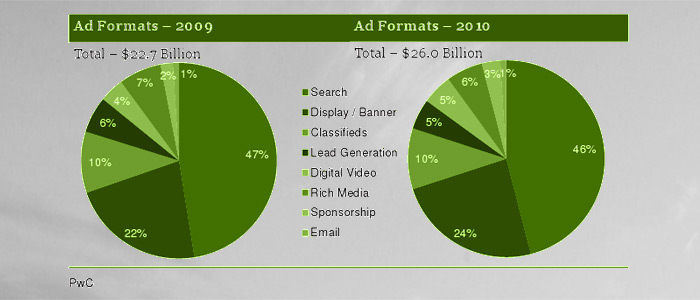
Display has shown good growth, driven by Social Media and led by Facebook. Facebook had approx 40% of all impressions in 2010 and passed the trillion mark with Yahoo next at half that amoun
Driven by the pull of Online Content
The growth in online content is pulling a greater audience online and keeping them there longer:-
- Stores (From Cars to Music)
- Entertainment (YouTube, BBC iPlayer etc)
- News (Mainstream to Blogs, Video to Text)
- Search
- Social Networks
The growth in richness of the online content is enabled by the growth in bandwidth to the home (in UK average is 6Mb and growing )and the penetration of internet globally.
And Online Advertising Cost Effectiveness
And the growth in the sophistication and cost effectiveness of online advertising:-
- Better targeting ( Using profiles on social networks and relevance by search or by product)
- Performance based pricing (Pay on Click through – accounts for 65% of all search advertising)
Use Value to drive Marketing Investment
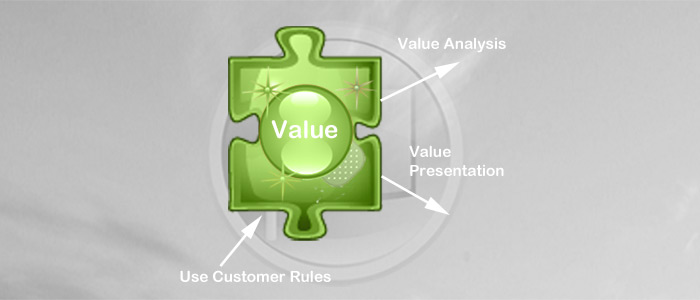
Use Value to drive Marketing investment
Value = Total Benefits-Total Investment.
The description of Value delivered by the marketing department will be much more powerful if linked to Value delivered to CEO and company objectives.
For instance the CEO may have a company objective
” increasing the Average Revenue Per User (ARPU) from £22 per month to £26 per month”
So a Value chain may be created that shows the Value that each department adds to the creation of this overall Value.
1. The Technical & Buying Departments must deliver a new data product for a specific investment
2. The Sales Department must generate a specific number of new sales by converting a certain percentage of qualified leads.
3. The Marketing Department must generate a specific number of qualified leads.
If you are selling equipment for a data product or a means of generating qualified leads then a conversation with the CEO based on the Value delivered in achieving his objectives will be better received and understood.
Equally, the marketing department will secure its budget easier if qualified in terms of delivering Value towards the company objectives.
